

"It is only a theory, Watson, but I venture to suggest that it fits the facts." Sherlock Holmes, “The Adventure of the Yellow Face”
Context and MeaningSource: Arthur Conan Doyle's 1893 short story The Adventure of the Yellow Face.The Situation: Holmes tells this to Dr. Watson after laying out his preliminary assumptions about a mysterious woman in a cottage.The Irony: This story is rare because Holmes's deduction is completely wrong. He assumes blackmail or a dark secret, but the reality turns out to be a touching family matter involving an interracial marriage and an adopted child.Would you like to explore the plot of "The Adventure of the Yellow Face" or discuss other times Sherlock Holmes made incorrect deductions?

RELATED POSTS
How The First Breguet Sympathique Ever Made Might Have Ended Up In America
"It is only a theory, Watson, but I venture to suggest that it fits the facts." Sherlock Holmes, “The Adventure of the Yellow Face”
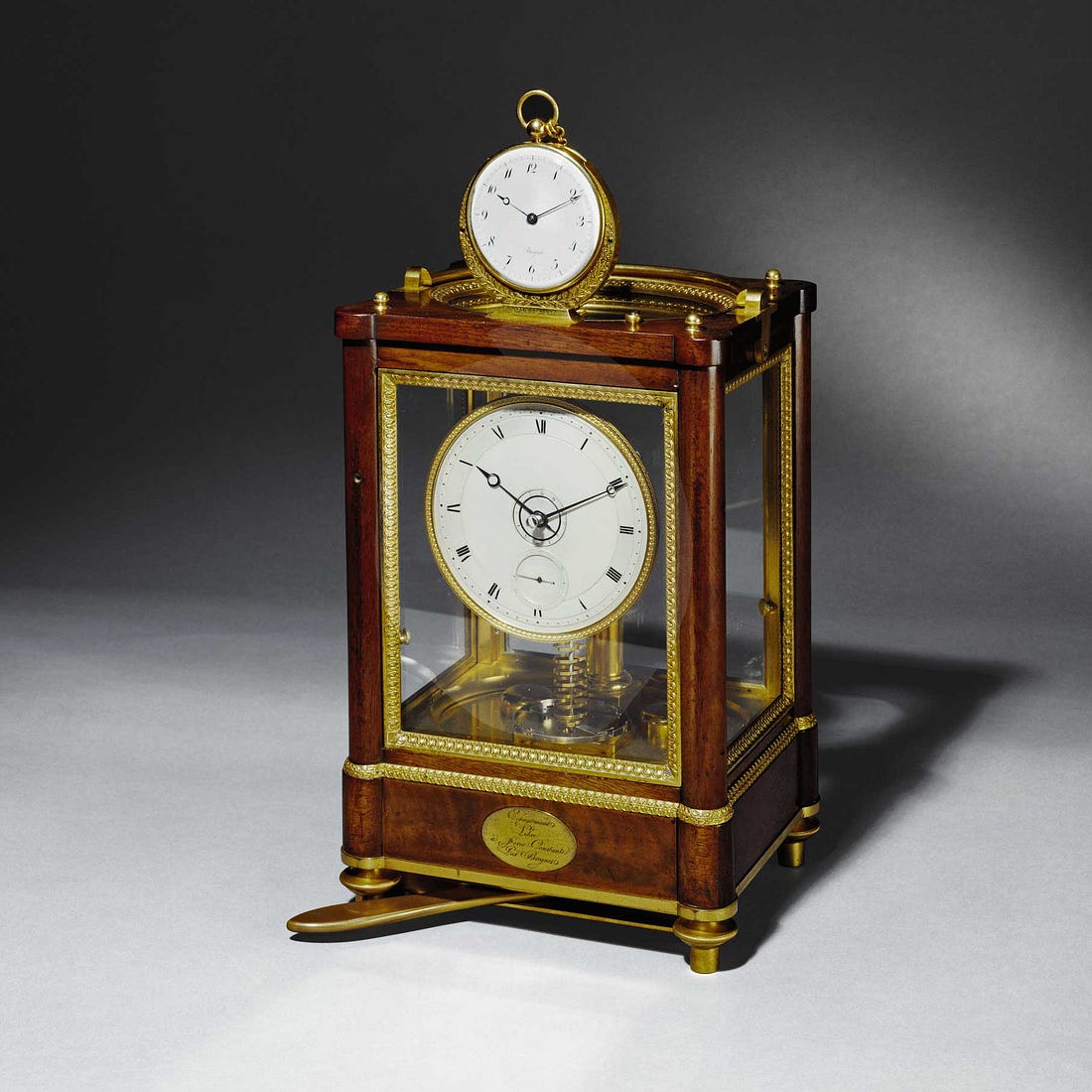
Over the last few months, the question of how many Sympathique clocks were made, and their whereabouts, has become for me a little bit of a minor obsession and one which is not likely to subside any time soon. This is partly thanks to the fact that there are some unsolved, and quite possibly unsolvable, mysteries surrounding them – in particular those made during Breguet’s lifetime, but also those made after his death and especially, during the period when Breguet’s grandson, Louis-Clément Breguet, owned the company. During that time, when the company was called Breguet, Neveu et Compagnie, production of Sympathique clocks resumed, but there is almost no information at all on the number made during this period, and I haven’t been able to find any information in auction records or museum catalogs describing them – with one exception. That exception is a clock, which is dated 1850 (on the clock itself) which is in the collection of the Spanish Royal Archives in Madrid, and is currently on public display in the exhibition, “The Precision of Timekeeping: 19th Century Clocks in the Royal Collection,” which ends on September 27th. I happened to find out about it while looking for something else: the locations of two Sympathiques which up until recently I (and others) had supposed to be in the Spanish Royal Collections as well: No. 46, and No. 247. An excellent article on SJX, “In-Depth: The Breguet Sympathique, From the Duc d’Orléans to ‘No. 1’” is an attempt to catalog the known Sympathique clocks, including the series of twenty made by Techniques Horlogères Appliquées (THA) the first of which was sold in 1991. The location, at least of most of the clocks in the article, is fairly clear, as a number of them are verifiably in private collections or in national museums. Numbers 46 and 247, however, are presumed in the article to be in the Spanish Royal Collections, but as the article states this information is speculative, and the author, well-known watch specialist Carlos Torres, sums up what very little was known of these clocks at the time of publication: “The Spanish Bourbon court was among the first to embrace Breguet’s mechanical innovations. In 1796, Queen María Luisa of Spain commissioned la péndola que pone el Relox a la hora, ‘the clock that sets the time of the watch,’ leading to the creation of Sympathique No. 46, delivered in 1799 and likely placed in the Royal Palace of Aranjuez. This was the earliest confirmed Sympathique delivered by Breguet, marking the start of a lasting relationship with the Spanish crown … After the Bourbon restoration in 1814, a third Sympathique, No. 247, entered the collection under Ferdinand VII. Each clock mirrors a different chapter in Spanish political life: enlightened monarchy, Napoleonic rule, and royal restoration. Though largely unseen today, Nos. 46 and 247 are believed to be held in the Spanish Patrimonio Nacional.” During the period 1808-1814, the Bourbon monarch, Charles IV and his son, Ferdinand VII, had been forced by Napoleon Bonaparte to abdicate and Napoleon’s older brother, Joseph, was placed on the Spanish throne. Charles IV was, I have read, something of a disaster as a monarch; he showed little interest in, or capacity for, matters of state. A former wrestler who was devoted to hunting, he has been described as “sluggish, despotic, and stupid” and his wife, Maria Luisa, was de facto the Spanish monarch, if not de jure. The phrase in Carlos Torres’ story, “are believed to be held” stuck with me and in the middle of this past August, when the watch news cycle reaches its annual low point, I decided to reach out to the Spanish Royal Archives and see if they had any further information on the two clocks. I was partly motivated by curiosity about the whereabouts of 46 and 247, but also by my discovery, in the course of researching the two clocks, that there was a monumental Breguet clock on permanent exhibition at the Royal Palace in Madrid: a planetarium, in the shape of a globe inside which the orrery is hidden, and which is supported by, as I thought at the time, a figure of Atlas. This planetarium, for watch enthusiasts at least, seems to have been somewhat hidden in plain sight, it is located in the Porcelain Room of the palace. The Patrimonia Nacional’s María José Pelayo provided the information in the catalog listing for the planetarium, which was for me a remarkable discovery in itself, and said that they had no record of any such clock or clocks. She recommended that I get in touch with Amelia Aranda Huete, who is the watch and clock curator for the collections at the Royal Palace and for the Patrimonio Nacional. I sent off an email to Huete on August 21, and did not immediately hear back, and I more or less forgot about the whole question for a couple of weeks, until I finally heard back from Huete on September 2nd – her reply, she said, was late as she’d been on vacation. What she had to say was most interesting, however. Subscribe to Split Seconds to unlock the rest.Become a paying subscriber of Split Seconds to get access to this post and other subscriber-only content. A subscription gets you:
|


 Posts








0 Comments