

The culture obsessive has created an indie media business that all started with one question over a cold call: ‘Can I write for you?’

Shea Serrano never intended to become a writer. He built a cult following as one anyway.
The culture obsessive has created an indie media business that all started with one question over a cold call: ‘Can I write for you?’ From Teaching to accidental WritingSerrano started his career as a middle school science teacher in Houston, Texas. In 2007, when his wife was placed on bed rest during a difficult pregnancy with twins, the family desperately needed extra income. He began freelancing for local Houston alt-weeklies and blogs, writing about anything that paid—from neighborhood events to hip-hop concerts. He had no formal training in journalism, which ultimately became his greatest asset. He wrote exactly how he spoke: conversational, deeply enthusiastic, and unpretentious.Building a Cult FollowingSerrano’s breakthrough came when he mastered the art of internet community building, primarily through Twitter (now X). His followers, dubbed the "FOH Army" (Friends of Houston / Friends of Honesty), grew into a hyper-engaged fanbase. He didn't just post articles; he built a communal experience.His rise to internet stardom was fueled by a few distinct elements:The Rap Year Book (2015): This book debated the most important rap song of every year since 1979. It became a New York Times bestseller and was later turned into a documentary series on AMC.Basketball (And Other Things) (2017): A collection of hilarious, highly specific basketball debates (e.g., "Which NBA player would be the best companion in a zombie apocalypse?"). Barack Obama famously named it one of his favorite books of the year.Aggressive Philanthropy: Serrano frequently used his massive platform to mobilize his followers for good. He would point his "army" toward random GoFundMe pages, teacher wishlists, or disaster relief funds, raising tens of thousands of dollars in mere hours.Staying True to the VoiceWhat sets Serrano apart is his rejection of traditional, stuffy sportswriting tropes. He treats pop culture, action movies, and NBA role players with the same intellectual weight and chaotic joy. Whether he is dissecting the filmography of Keanu Reeves or analyzing a random regular-season basketball game, his work is driven by pure fandom.He eventually transitioned into television, creating the IMDb TV/Amazon Freevee comedy series Primo (2023), which was loosely based on his own upbringing in a large Mexican-American family in San Antonio.
Welcome to Double Take: a dual feature series from The Substack Post and On Substack. Part culture, part business, all encompassing. This edition, we’re featuring Shea Serrano, the author and writer behind the newsletter, Good Movie, and the newly-launched podcast, Organizing Things. Shea previously wrote for The Ringer, is a five-time New York Times bestseller, trailblazer in digital media, and most importantly, a film fanatic.
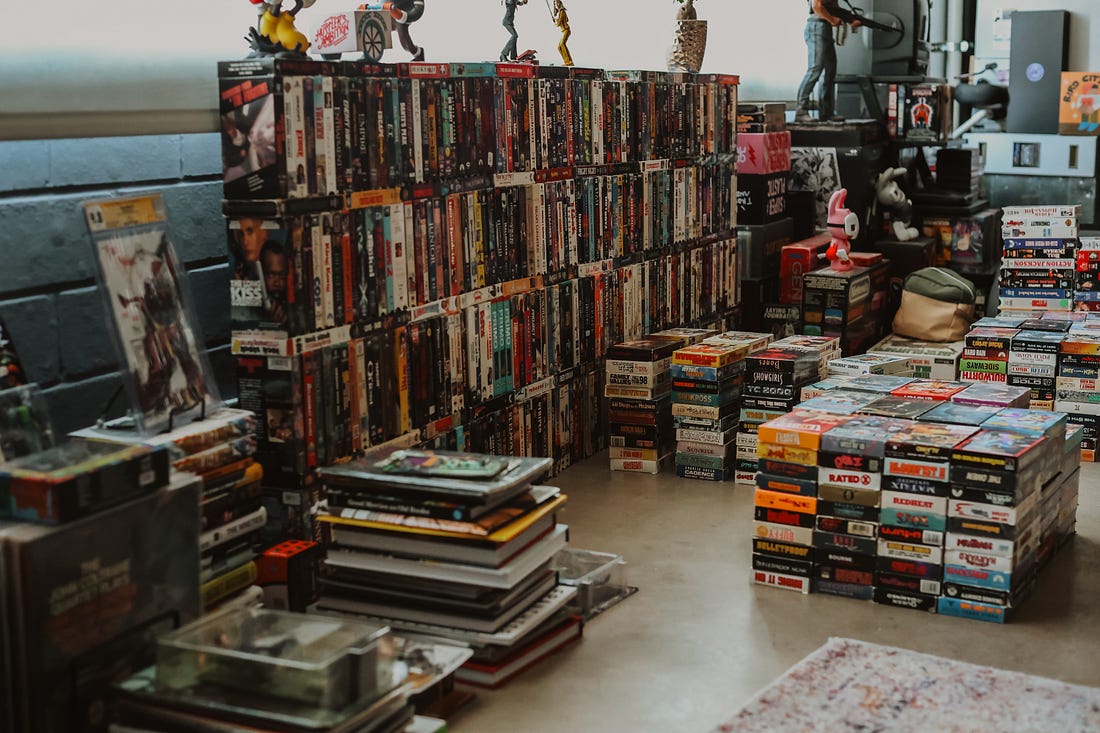
On the walls of Shea Serrano’s San Antonio office live hundreds upon hundreds of VHS tapes (1,319, to be exact): Napoleon Dynamite. Cool Hand Luke. The Sandlot. Rush Hour. Catwoman. Taxi Driver. The Shawshank Redemption. Every single film is cataloged in a running Google Doc. Shea’s favorites, about 400 of them, are lined up next to one another in alphabetical order on wired shelving units. His prized possession, a copy of his favorite “flop at the box office” movie, Blood In Blood Out, resides here in a prime position. It took him years to track down, since he only allows himself to purchase VHS tapes in person from places like swap meets, thrift stores, and flea markets. The rest, the Forrest Gumps, the Sleepless in Seattles, the Scarfaces occupy overflow seating, i.e. stacked in piles or secondary cases across the room. “I started collecting them totally by accident,” Shea says. “I left teaching to become a full-time writer, and I got my first office—a sublet in a small section of a personal-injury lawyer’s office. It only had room in there for one desk and one IKEA bookshelf.” Slowly, Shea began filling that shelf with movies from the thrift store near his house until the hobby snowballed into a fixation. “At some point, I just decided I’m going to buy every single movie that I’ve seen. I’m just going to hunt it down. I have been doing that now for 11 years.” 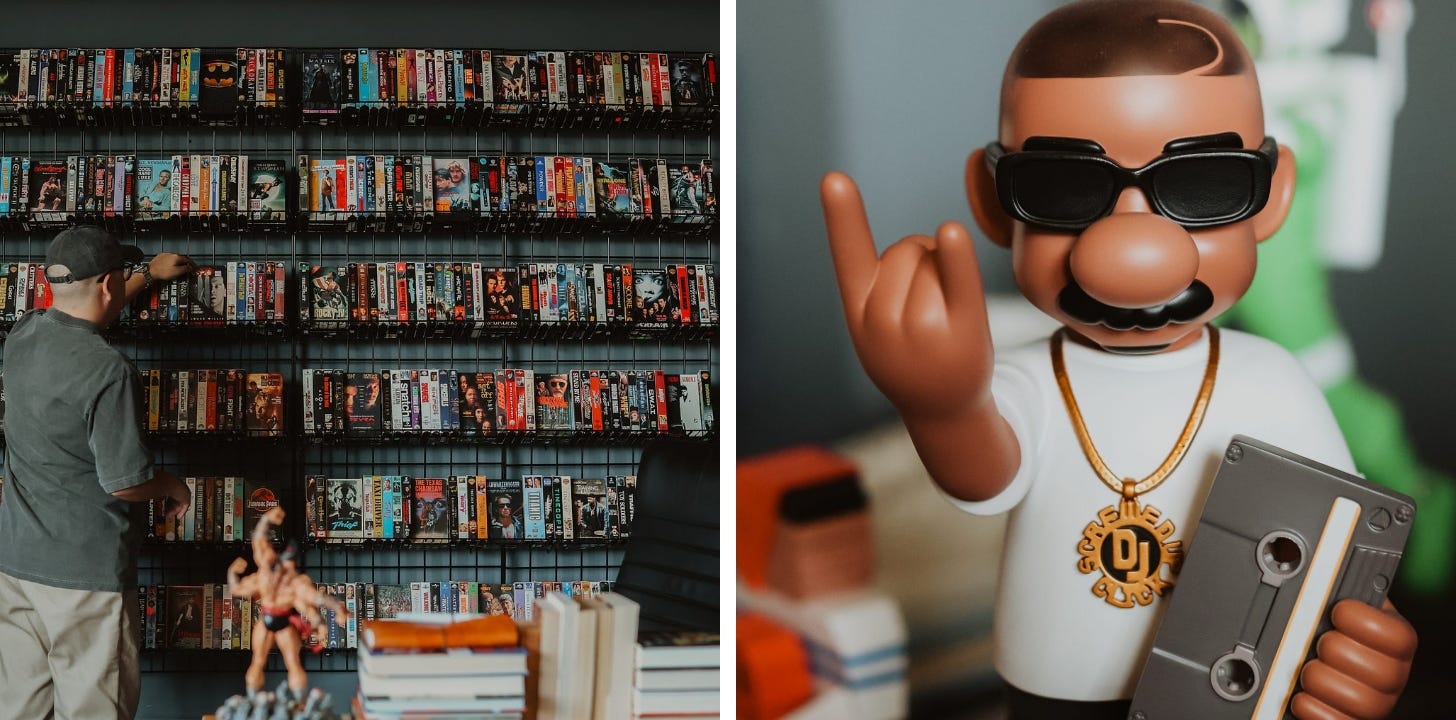
It might seem obsessive—the cataloging, the archiving, the foraging—but that’s kind of Shea’s bread and butter. He’s a culture buff who flourishes within the confines of specificity. His Substack, Good Movie, hinges on this concept in part, with pieces like “The Stats Behind Harry’s Run in When Harry Met Sally,” in which he asks such critical, yet oft-overlooked questions as What was [Harry’s] top speed? How many calories did he burn? How many steps did he take? What was the weather like that night, and did it help or hurt his performance? How far did he travel, and where does that distance place him in the pantheon of other rom-com runners? What was Harry’s average mile time? Or wonders “How Many Questions Are Asked in Each Christopher Nolan Movie?” (445 questions during Inception’s 148 minutes of runtime). Or uncovers that Jimmy from 2 Fast 2 Furious is actually the least fast (jury’s out on his fury) character in the entire franchise. His new podcast, co-hosted by fellow writer Jason Concepcion, Organizing Things, is built on the premise that films can be broken down into nitty-gritty categorizations: “Movies the Worst Guy You Know Says Are His Favorite” or “All the Stuff That Happens in The Wolf of Wall Street.” It’s the same devotion to film minutiae that others overlook that he’s built into both a career and a burgeoning cultural destination. The title is self-explanatory, the concept is simple enough, and yet no one apart from Shea, who never even expected to become a writer, let alone a podcaster, has been able to launch the idea into the world.
Shea Serrano was born and raised in San Antonio with his three younger sisters. His parents, who were just 17 at the time, both dropped out of high school when he was born to go into the workforce, with his father ultimately forging a guardian’s signature to enlist in the Army, underage. “We grew up on welfare and Section 8 housing,” Shea says. “That being said, everybody I grew up with was living the same life, so I didn’t know that wasn’t how it was. You watch whatever movies, and they’ll tell you that every poor neighborhood is the most dangerous place you’ve ever been in your life. Crimes were happening where I was growing up, but I never felt unsafe or unloved or like I had been abandoned or whatever.” It was in this neighborhood that his love for film was first nurtured. At around 8 years old, Shea saw his first movie ever, Kickboxer, starring Jean-Claude Van Damme. “I was just sitting there seeing a very handsome, muscled-up dude who is protecting everybody,” he says. “And I was like, ‘That’s fucking cool.’” But the movie that altered the course of his life and sent him down a never-ending path toward cinematic salvation, came in the form of Mortal Kombat. His uncle and aunt had taken a 14-year-old Shea along to see the release, a spin-off of the popular ’90s video game of the same name. “I felt like my brain was on fire watching it. I just couldn’t believe what I was seeing,” he says. “I felt like my heart was going to explode. I wanted to just stand up and start clapping. And it was right around then where I was like, ‘This feeling I have right now, I’m going to chase this feeling forever.’” It would take decades, well into his following an entirely different career path, for Shea to uncover that sensation, the joy of movie magic, in his own work.
“Right around 17 or 18, when you’re graduating high school, the world starts to press itself down on you,” Shea tells me. “It was very clear to me that the neighborhood was eating up some of my friends already. I knew I needed to get out of there. Otherwise, all the stuff that was happening to everybody else was going to end up happening to me, and my mom knew it too.” After graduating—the first in his family to do so—his mother gave him an option: college or the military. “She was like, ‘Great, I’m proud you finished high school. Way to go. I’m going to drop you off at Sam Houston State or I’m going to drop you off at Fort Sam Houston.” Shea chose the former. After a brief stint studying criminal justice (“It looked cool to me to have a leather gun holster under your sports jacket”) that ended after Shea found analyzing photos of a real-life murder scene unsettling, he pursued a degree in psychology with the intention of becoming a teacher and school counselor. “Teaching was like the first job that I had where it was hard and I didn’t want to quit. When you encounter the moment that it gets hard, you either say to yourself, ‘I’m going to get out of here and do something else,’ or you go, ‘Oh, I want to be good at this. I’m going to work to be good at this,” he says, comparing his first year in teaching to Dangerous Minds. In that film, Michelle Pfeiffer plays a Marine turned high school teacher who is metaphorically run off by her students on her first day. Rather than throwing in the towel, she doubles down. “That’s what happened with teaching,” Shea says. “I thought I was going to do that job forever, honestly. I had no idea writing was nine years away.”
It wasn’t until 2007, though, that he made his foray into journalism. His wife, Larami, pregnant with their twins, was experiencing medical complications that confined her to bed rest. The expectant parents were now down an income stream and completely reliant on Shea’s marginal teaching salary. “In my head, I was thinking, ‘All right, well, I just need to float us for these five months. I need to make an extra $400 or $500, and that’ll keep us with a house and a car,’” Shea recalls. He applied to Target, Walmart, and various restaurants in the area, only to hit a wall in the hiring process because he already had a full-time job. “I couldn’t work when they needed me to work. I was like, ‘Fuck, what am I going to do?’” At his wit’s end, he turned to Google, looking up occupations and side gigs he could do from home. “Writer” popped up as an option. “All you needed, to my knowledge, was the internet and the computer. I was like, ‘Well, I got both of those, so I’ll try to do that.’” He figured if he was working every day from around 6 a.m. through 7 p.m., hoping to spend some time with his wife and one day his children, he’d have around two hours a night to write, or 56 hours a month. “I needed to make over $500 with those 56 hours. So any writing assignment I took on, I needed to be averaging probably somewhere between $15 and $20 an hour.” Shea took to cold-calling local newspapers around Houston, where he was living at the time. “I’m a writer. Can I write for you?” he’d ask editors over the phone, often to be told, “It doesn’t work like that.” But he was tenacious, and eventually convinced the alternative weekly the Houston Press to take him on in a freelance capacity, writing about the local rap scene. He leveraged those clips into bylines for bigger publications: the LA Weekly, the Village Voice, MTV, ESPN. By the end of his first year freelancing, he was making an extra $1,000 a month and found himself wondering if he could double, even triple, that income. Nine years into his career’s double life, Shea officially left teaching for a full-time job at Bill Simmons’s Grantland, quickly followed by a gig at The Ringer, where he spent six years. “To be [at The Ringer], to be with that group of people—you’re in a room with some of the most talented writers in the country, getting to pitch ideas with them,” Shea says. “You’re talking about sports with Bill Simmons or pop culture with Mallory Rubin and Jason Concepcion or movies with Sean Fennessey and Amanda Dobbins. You’re getting to do all that stuff, and it just feels cool. It feels like, ‘Am I in this? Am I in this group?’” While at The Ringer, Shea did what he does best: podcasting and writing about the little things across sports and culture that get lost in the big picture. He wrote about Tim Duncan, Houston, the World Series, all through his highly specific blend of dry humor and earnestness. Meanwhile, in a prescient move, he shared his pieces and opinions on Twitter, building something that’s now considered a critical component of a successful writing career: a massive and tapped-in audience. He first realized the power an online following could wield sometime around 2013. Shea had published a rap coloring and activity book, taking part in the typical song and dance of a traditional media press push: coverage in the Los Angeles Times, Rolling Stone, a spot on MTV. His book sold only about 1,000 copies, which didn’t “seem right” to him. How could all that chatter generate so few sales? He posted an Amazon link to the book from his Twitter (now X) account. A few hours later, the book was the number one bestseller in rap, and within a week it had sold 8,000 copies. “I realized that [an online presence] could be weaponized,” Serrano says. “Everything sort of changed from there.”
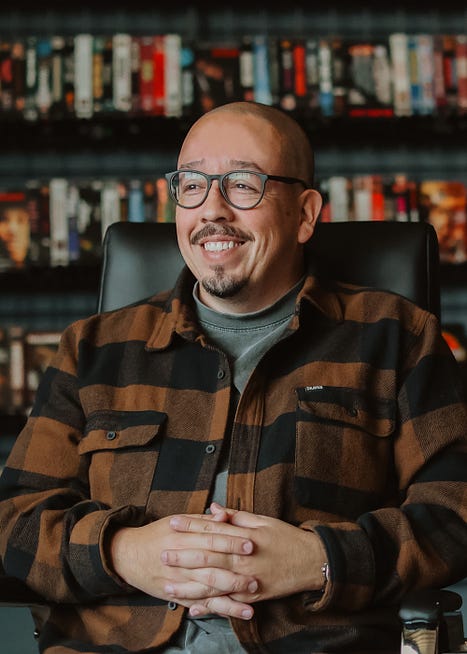
Over the years, Shea became a near inescapable presence across social media. (On Twitter, he was my own introduction to the world of cultural criticism when I was still a teenager.) Nowadays, across Substack, X, and Instagram, he has amassed an audience of more than 600,000 subscribers and followers that have turned into an engaged, culture-hungry community in his newsletter’s chat, debating the best movie villains of all time (Hannibal Lecter and Jordan Belfort make the list) and greatest single-location set design (The Invite, The Truman Show) and pitting Tom Hanks’s filmography against Leonardo DiCaprio’s (the verdict is split but leaning heavily toward Hanks). He’s leading watch-alongs, with corresponding threads, of The Thomas Crown Affair, Spider-Man: Brand New Day, The Odyssey. Shea’s readers, and now listeners, are just as obsessed as he is with culture and with the people, places, and intricacies that make movies tick. He’s taken that audience wherever he’s gone, from The Ringer to his five New York Times bestselling books and now, working on his own, to his Substack. While he’s been able to drum up a substantial business from this subscriber base, he has also leveraged it for good: raising $3,000 for a parking lot attendant, $134,000 for Hurricane Harvey victims, and, most recently, funding transportation to get Adrian, a student from San Antonio, to his scholarship at Vanderbilt. “I think it’s a net positive,” Shea says of social media. “I don’t know how you exist as a writer without it. But I do daydream about not being on the internet. My number one writer fantasy is: I live in a cabin in the woods, on a mountain, and I have a big beard and a heavy sweater and I type a novel over four years. Then I give it to somebody and I disappear, and then the novel sells itself. Could you imagine your writing selling itself? That sounds awesome, but I can’t do that. I have to post online.” 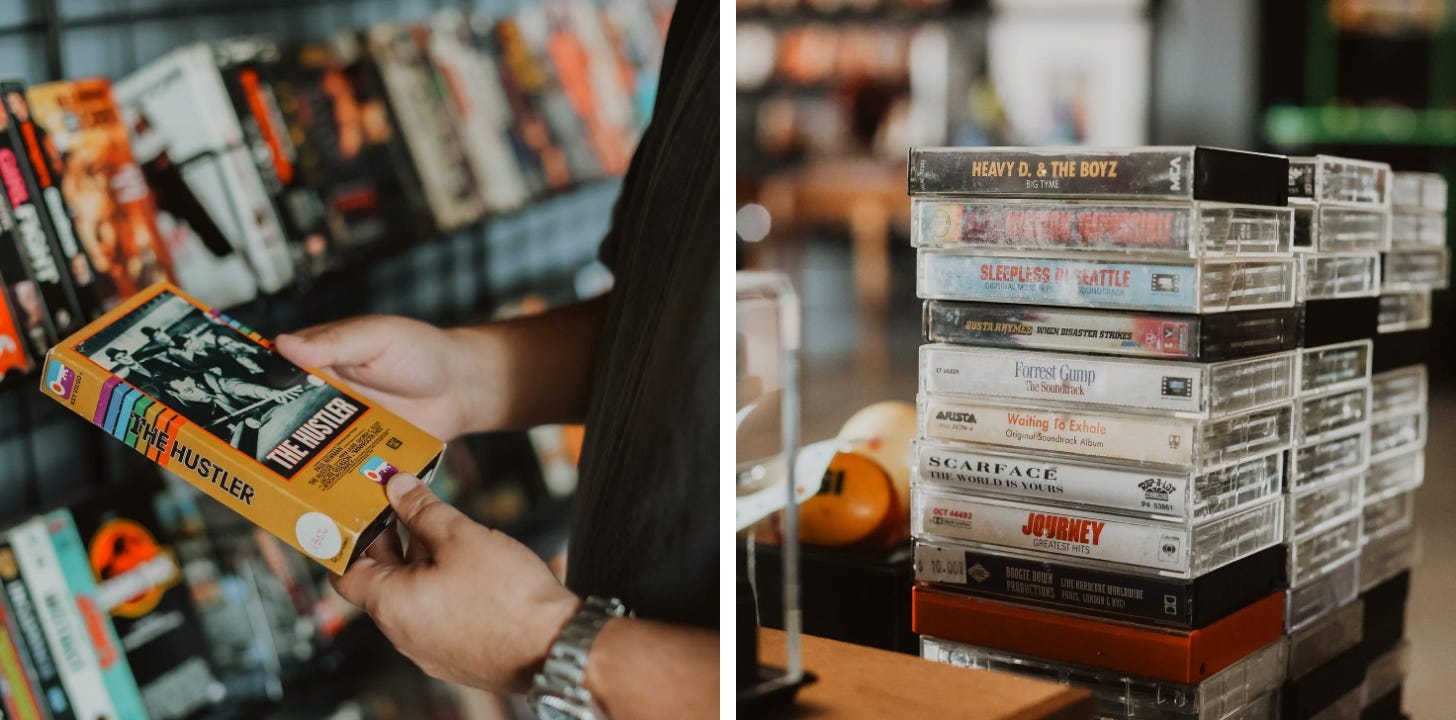
That desire to post, the necessity of it as a creator in the modern age, coupled with his urge to bet on himself and his independence, has brought Shea here, to the launch day of his newest podcasting venture. He tells me he spent years averse to the thought of it—“I just wanted to write and go about my business”—but after he got the cadence of his newsletter down to a science, he got the itch to expand his body of work. He realized he could write notes out beforehand rather than simply going off the cuff, “I can sound smart if I do that,” Serrano jokes, and build off his existing articles—and vice versa. Podcasting has become a symbiotic complement to his writing. “It just seemed like something I wanted to try,” he says. “It’s just a fun thing to work on, especially if you get to do it with somebody who is (a) your buddy and then also (b) as talented as Jason is.” Then there’s the money. Shea does the math aloud for me: “I’ve done enough of these things to know that if we were to take this specific project somewhere else, I would probably get maybe four grand per episode,” he says. “I know I have that number here on Substack. If I can get more paid subscribers, then I’ll come out a little bit ahead and be able to do it all on my own.” Shea’s approach to his work in general is more mathematical than meets the eye. The way he speaks about his current business venture and foray into independent media is a throwback to his entry into journalism: both are broken down by metrics, numbers, and figures that tell him whether he can stay afloat. “That was a thing I learned early on,” he says. “That’s the pressure of, if you’re a parent or a husband or a wife, being responsible for other people.” Despite the knowledge that people are counting on him financially, Shea keeps coming back to the joy of movie-watching as part of a community, of writing in the public sphere for a rapt audience. None of that happens without taking a chance, without putting oneself out there the way he does now, the way he did almost 20 years ago when he cold-called the Houston Press. “At least for the beginning of your career, you’re going to be told no almost exclusively,” Shea says. “You just have to decide: are you going to keep going or are you not going to keep going? That’s really all there is.”
For a closer look at the numbers behind Shea’s business model, read our companion piece in On Substack.
|







 Posts








0 Comments