I was sitting in a small diner outside of Alpine, Texas, eating a breakfast burrito when the woman behind the counter asked where I was headed. I told her Marfa. She nodded slowly, the way people do when they’re deciding whether to say the thing they’re thinking. Then she said it: “You going to see the lights?”
I had expected this. What I had not expected was what she said next.
“I saw them once, twenty years ago. Came back the next night to look again. They were in a completely different place. And they moved wrong.”
I asked her what she meant by “moved wrong.” She wiped down the counter, thinking. “Like they knew I was watching.”
I wrote that down. Not because I believe lights have awareness. But because that phrase, “moved wrong,” turned out to be more scientifically interesting than I initially thought.
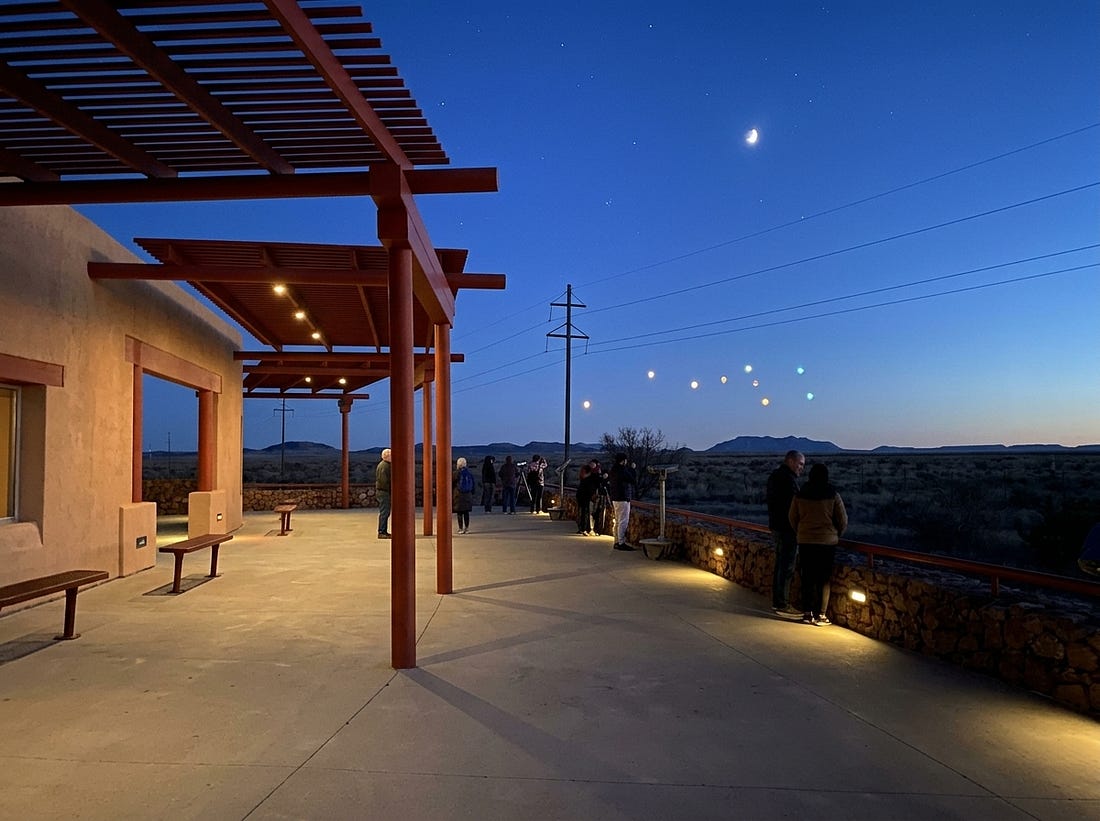
The Marfa Lights are a real, documented, recurring atmospheric phenomenon observed near Marfa, a small town in the Chihuahuan Desert of West Texas. The lights appear most frequently east of town, near Route 67, over the Mitchell Flat. They are best observed from a dedicated viewing area the state of Texas officially installed in 2003, which should tell you something about how seriously people take this. Texas put a parking lot there. This is not folklore.
The lights have been reported since at least the 1880s. A rancher named Robert Reed Ellison is usually credited as the first documented non-indigenous observer, though the Chisos Apache had their own accounts of the lights long before that. They described them as stars that had fallen from the sky and were searching for a way back up. I find that description more poetic and possibly more accurate than most scientific explanations I’ve read, and I’ll come back to why.
The lights vary. This is important. Some appear as single white orbs. Some come in pairs. Some are yellowish or reddish. They hover, split apart, merge, drift, and occasionally appear to chase each other. They are not visible every night. They are not visible from every location. And they do not behave the same way twice.
There is a permanent historical marker at the viewing area. It calls the Marfa Lights “mysterious and unexplained” and says they’ve been reported in the area for over a hundred years. It mentions the first recorded sighting in 1883, then runs through the possible explanations: campfires, phosphorescent minerals, swamp gas, static electricity, St. Elmo’s fire, and even “ghost lights.”
Texas apparently wasn’t interested in picking a side. I appreciate that.
Here’s where I want to slow down, because most articles about the Marfa Lights do one of two things. They either treat the whole thing as obvious folklore that credulous tourists fall for. Or they go full supernatural and start talking about portals. Neither of those approaches is useful.
The detail most people skip over. The lights were documented before cars existed in that area.
This matters because the most widely accepted scientific explanation is that the Marfa Lights are car headlights from Route 67 and Highway 90, refracted through layers of warm and cool desert air. This explanation is called atmospheric refraction or sometimes a Fata Morgana variant. It’s a real optical phenomenon. It can cause distant lights to appear elevated, split, or to seem to move in unusual ways.
In 2004, a group from the Society of Physics Students at the University of Texas at Dallas conducted a four-day field investigation. They found that many of the lights they observed correlated with automobile traffic on U.S. Highway 67, and they were able to reproduce the appearance of a Marfa Light by flashing headlights from the highway.
A few years later, researchers including Karl Stephan of Texas State University conducted a different, instrumented investigation. In a 2011 paper, Stephan and his colleagues analyzed an unusually bright object photographed near Marfa on June 3, 2005.
But Robert Reed Ellison saw the lights in 1883. There were no highways. There was no significant automobile traffic in the Chihuahuan Desert for decades after that. And the Chisos Apache accounts predate him by generations.
So either the phenomenon people observed in 1883 is genuinely different from what people observe today (possible, and actually worth considering), or the car headlight explanation is at best a partial answer that explains some of what people see but not all of it.
I lean toward both being true simultaneously. I’ll explain why.
There’s a second detail. Witnesses with no prior knowledge of the lights sometimes report them from unexpected angles. Not from the direction of the highway. Not from the east, where the viewing area faces. From the south. From directly above. From behind.
You can dismiss some of these as misremembering or disorientation in a featureless dark landscape. The desert at night is genuinely disorienting. Depth perception collapses. Distances become impossible to judge. I know this from personal experience.
But not all of these accounts can be explained by disorientation. Some come from trained observers. A pilot named Fritz Kahl, who lived in the area for years, insisted the lights he saw were not explainable by traffic. He had spent enough time around aircraft navigation lights and runway lighting to know what refracted artificial light looks like. His account is often dismissed without engagement.
Why do we dismiss the careful observers more readily than the casual ones?
Let me lay out the serious explanations and what each one actually gets right and wrong.
ATMOSPHERIC REFRACTION
This is the strongest explanation for a significant portion of modern sightings. The Chihuahuan Desert creates dramatic temperature inversions, particularly at night when the ground releases heat rapidly. These inversions bend light in ways that can make sources appear to float, multiply, or shift laterally.
What it explains well: the hovering quality, the splitting behavior, the general geography of where the lights appear relative to the highway.
What it doesn’t explain well: pre-automobile sightings, lights reported from unexpected directions, and the color variations that don’t match standard headlight spectra. Yellow and red lights in particular are harder to account for if the source is white LED or halogen headlights being refracted through dry air.
PIEZOELECTRIC OR SEISMIC LUMINESCENCE
This one is less well-known and more interesting. The Marfa area sits near fault lines. There is a documented phenomenon called earthquake lights or seismic luminescence, where tectonic stress on certain types of rock can generate electromagnetic fields strong enough to produce visible light. This sounds implausible until you realize it has been photographed and documented in multiple seismic zones around the world, most extensively in Japan.
The mechanism is genuinely not fully understood. Some researchers think it involves the piezoelectric properties of quartz-bearing rocks under compression. Others have proposed plasma formations. The honest answer is that earthquake lights are real but not well explained even by the people who study them.
What this explains well: the pre-automobile sightings, the irregular schedule (the lights don’t appear every night, but seismic stress is also irregular), the variety of colors, and the strange movement patterns that don’t map to any road.
What it doesn’t explain well: why the lights appear in the same general area rather than tracking fault line activity more broadly. Also, Marfa has not historically been a high-seismic area, though minor activity does occur.
BALL LIGHTNING
Ball lightning is a real phenomenon that physicists have not fully explained despite decades of trying. It is a floating, self-contained orb of electrical plasma that can persist for several seconds to several minutes before dissipating. It has been observed worldwide and has even been captured on video in a few cases.
The problem with ball lightning as an explanation for Marfa is persistence. Ball lightning typically lasts seconds. The Marfa Lights can be observed for minutes or even longer. Unless what people are seeing is a rapid succession of discrete ball lightning events that the human eye groups into a single continuous experience, which is at least theoretically possible, ball lightning doesn’t fit the timing.
The Marfa Lights are probably not one phenomenon. They are probably several phenomena that get lumped together because they occur in the same geographic area and share a superficial visual similarity. Some of what people see is almost certainly refracted highway traffic. Some of what people see might be seismic luminescence. Some might be ball lightning. A small fraction of accounts might be genuine misidentification of stars or aircraft under unusual desert atmospheric conditions.
This is unsatisfying if you want a single clean answer. But it’s actually a reasonable conclusion given the available data.
The more interesting question to me is why our brains insist on finding a single explanation. There’s a cognitive tendency called “explanation inflation,” a form of motivated reasoning where we feel compelled to resolve ambiguity with a single cause. Uncertain, multi-causal explanations feel unstable to us even when they’re more accurate. So we pick the one we like. Skeptics pick refraction. Enthusiasts pick something weirder. Both camps are doing the same cognitive thing.
I went to the viewing area on a clear night in late March. The temperature had dropped fast, which I had read was a good sign. I stood there for about ninety minutes with a handful of other people, maybe eight or ten, and we watched the darkness east of the Chinati Mountains.
I saw lights. Two of them, at the same time, low on the horizon. They were white and steady for maybe three minutes. Then one of them drifted left and faded. The other persisted for another couple of minutes before disappearing.
Now, was that refracted headlights from the highway? Honestly, probably. The timing felt consistent with traffic. One appeared, then another, then they faded in the way something would if the road curved away.
But here’s what I couldn’t explain to my own satisfaction. About forty minutes later, there was a single light. Reddish. Higher on the horizon than the first two. It didn’t drift. It pulsed, or appeared to, though I am genuinely uncertain whether that was a property of the light itself or my own visual cortex responding to staring into the dark for too long. The human eye is not a reliable instrument when it’s bored and mildly cold and looking for something.
That light bothered me. Not because it was frightening. Because it didn’t fit the pattern I’d set up in my own head for what the refraction explanation predicts. And whenever something doesn’t fit my working model, I want to know why.
I still don’t have a clean answer for the red light.
There’s a broader pattern I keep noticing as I work through unexplained phenomena. The cases that resist simple explanation usually resist it for one of two reasons. Either the phenomenon is genuinely novel and science hasn’t caught up, which is rare but does happen. Or the phenomenon is actually multiple overlapping things that get treated as one, which happens constantly.
The Marfa Lights are probably the second type. But the pre-automobile accounts are a genuine puzzle that the dominant explanation doesn’t handle well, and I think that deserves more honest attention than it gets.
The woman at the diner said the lights moved wrong. I think she was describing something real, whether she was watching a seismic event or a refraction she wasn’t expecting or something else entirely. The desert at night doesn’t organize itself for our convenience. It doesn’t produce phenomena that fit our categories.
That might be the most honest conclusion here: not “the lights are paranormal” and not “the lights are just headlights,” but something closer to “the desert does things we don’t fully understand yet, and some of those things have been happening for longer than anyone has been around to explain them.”
I find that more interesting than a definitive answer would be.
If you’re interested in this kind of thing (cases that don’t resolve neatly, mysteries that resist easy answers), I’m documenting more as I find them.




 Posts








0 Comments