

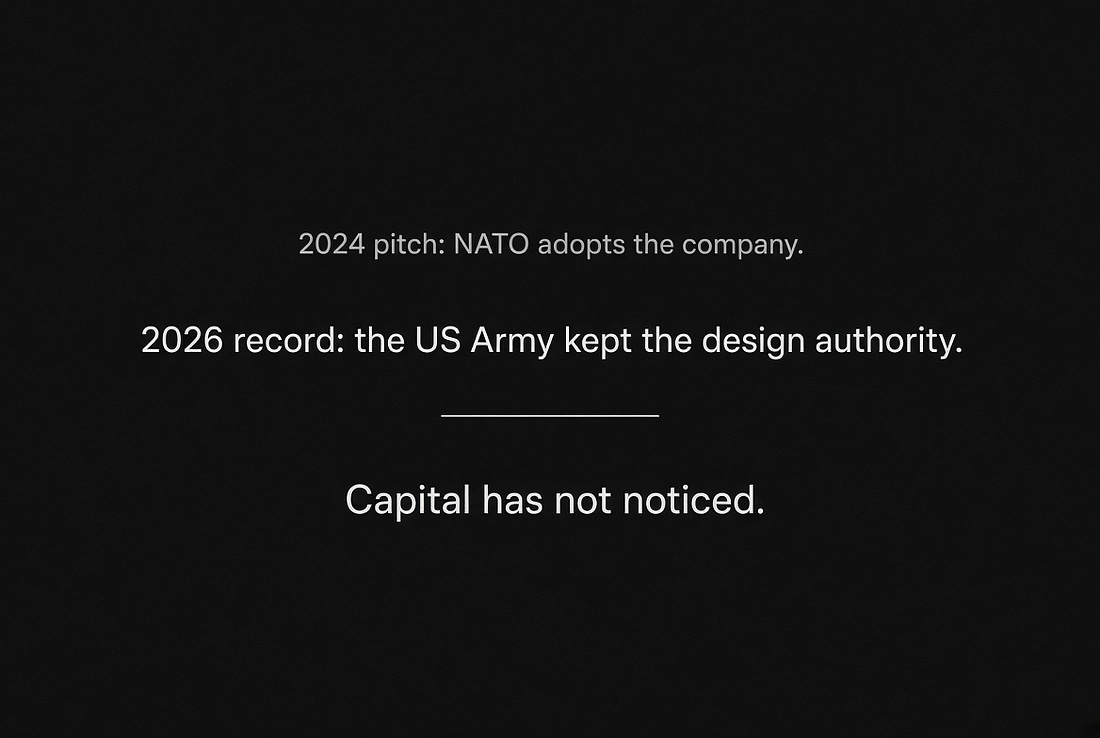
Combat-proven in Ukraine is not a multi-year NATO contract. The US Army kept the design authority. Capital is still pricing 2024.

RELATED POSTS
This Is Not 2024, People. VCs Got It Wrong and Are Still Ignoring the Realities of 2026
Combat-proven in Ukraine is not a multi-year NATO contract. The US Army kept the design authority. Capital is still pricing 2024.
Combat-proven in Ukraine does not mean NATO countries will put that company on a multi-year defence contract. A lot of live raises are incomprehensibly still using the first sentence. The US Army, and then Europe, already wrote the second. I posted a shorter version of this on LinkedIn. This is the full version. The 2024 raise in Ukrainian miltech was simple. A company had flown, hit, or detected something in the war. The slide said combat-proven. The implication was that NATO would adopt the company: official kit, multi-year orders, a Western cap table. Cost was the moat. Hours were the proof. An Estonian holding company was the exit. That was a reasonable inference in 2024. It is not how Western buyers are behaving in 2026. Those Western defence buyers took the requirement but they never relinquished the design authority. They still pay for Ukrainian output. They do not put a Kyiv company on the books as the official supplier of their own force. Paying Ukraine to build drones for this war is not the same as making a Ukrainian company the official long-term supplier of a Western army. Too many pitch decks treat those as the same. They are not. What “Not the Design War” MeansA design war is the fight a country uses as the model for its own army: how it organises, what it buys, where it builds, and which company it puts on contract. I have been in Izyum. I have sat through hours of 3AK leadership saying Ukraine is the only country that knows how to fight. They have earned the right to say it. I told them, unpopular as usual, that this is not the war the West will fight. That is not a slight on Ukraine, or on the people who have held this line against impossible odds. It is what the US Army has actually done. The United States learned the physics of cheap mass, short update cycles, a low air space full of drones, and electronic warfare as a daily condition. Units picked up tactics. The Army did briefly put those lessons in one formation. The officers around that experiment have been moved on. The formation is reverting. What did not happen is the other half of the 2024 pitch: a Ukrainian company as the official supplier of US kit years from now. A programme of record is an official, multi-year buy for their own force. Named requirement. Budget line. Vendor of record. That has not happened either. An aid lot is not that. An exercise is not that. “NATO-codified” on a slide is not that. An NCAGE code, a catalogue entry, and a qualification trial are not a funded national buy. The 2024 pitch treated the first three as if they were the fourth. Used in Ukraine is not adopted by a NATO army. US Actions Raises Have Not PricedIn January 2026 the US Army designated 3rd Battalion, 504th Infantry, 173rd Airborne, as an unmanned-systems battalion so one formation could absorb Ukrainian lessons. After Saber Junction 26 that battalion is returning to airborne infantry. Congress asked questions. The unit is still reverting. That is the position in one administrative act. The Army stood up a specialist node to steal the Ukrainian problem set. It then folded the node back into the line. The rest of 2025 and 2026 is the same decision written several times. The April 2025 transformation memo put unmanned systems and launched effects into every division by the end of 2026, and counter-UAS into platoons and then companies. The July 2025 drone-dominance directive put low-cost expendable drones into every Army squad by the end of FY2026, Indo-Pacific units first. Units may modify airframes. Buy American. Blue List. Treat small UAS as ammunition, not as aviation end items. First-person-view flying is often extra duty on an 11B. Army CTO Alex Miller said in September 2026 that the Army has pushed back on a drone corps since the idea appeared, because parking the problem in one place stops the learning from scaling. Combined Resolve put US brigades against Ukrainian drone hunters. Saber Junction 26 put about two thousand unmanned systems in the box and showed a Ukraine-style fight. The institutional answer was a tactics rewrite and more kit in line units. Not a US drone corps. Not a Ukrainian firm as the official supplier of US kit. Two different products sit under the word “drone,” and decks keep smooshing them together. One is the expendable in the rifle company: cheap, commander-owned, spent like ammunition. Most Ukrainian “EW / interceptor / DF / seeker” stories are not official kit on either list. “EW-aware” in a US requirement will be specified as an American function on an American airframe. The failed first attempt at attritable mass is part of this file, not the moral of it. Washington still wants cheap volume. What followed was marketplace buying, a joint unmanned office above the Army programme executives, and American vendors of record. Where Ukrainian hardware has entered US demand, the next order has been tied to production on US soil. The United States will take a design. It will not take the factory. The Army stood up one battalion to hold the Ukrainian lessons. It is now putting that battalion back to ordinary infantry. If US units are short of doctrine, specialist trades, electronic-warfare integration, and a standing Ukraine feedback loop, that is a US problem. American marketplace vendors will be paid to close it. The gap does not put a Kyiv company on the programme of record. The strategy language sits on top. Homeland first. China as the pacing problem. Europe as burden-sharing. The first small-UAS fielding clock is the Indo-Pacific. That geography alone should have weakened the idea that a library built against Russian emitters automatically becomes US official kit. None of this is subtle. It is memos, unit designations, exercises, and contract conditions. Europe Copied the Split and Kept the Second ChequebookEurope did not appoint Kyiv as designer. It kept paying for Ukrainian production. It did not hand over design authority. Frontline states cannot treat Russia as a side problem. They still write large cheques into Ukrainian lines. They still insist the factory, the title, and the official kit sit in a jurisdiction they control. Britain. Programme Lyra. Project Octopus: a Ukrainian-designed interceptor, built by UK industry in the UK, targeting thousands a month. GOV.UK said the aircraft are to provide to Ukraine. A defence minister told Parliament the first UK units would be sent to Ukraine for testing and operational deployment. The MoD told Janes the UK would provide Ukraine with thousands every month. London keeps the plant. Kyiv keeps the update cycle. That is not a British Army equipment programme. A Ukrainian firm producing directly in Britain sits outside Lyra. Lyra exists to use British manufacturers. Germany. Berlin funds Ukrainian designs through German companies. Quantum Systems used Ukraine as the combat résumé, sells the Bundeswehr, sits on the US Blue UAS list, and runs Build-with-Ukraine joint ventures that put Frontline, WIY and Tencore designs onto German lines. Berlin has also funded large SkyFall strike lots running Auterion software. The German company is the wrapper. Ukraine supplies the design input and the hours. Poland. Frontline spend, title at home. The SAN drone wall is PGZ and Kongsberg. Warmate, FlyEye and Gladius are WB Group. Hornet is a Polish design whose intellectual property sits with the Ministry of National Defence. Poland shops the Pentagon counter-UAS marketplace and hosts US presence. That is demand. It is not a Kyiv architect for the Polish force. The Commission. The EU-Ukraine Drone Alliance is nine European firms and nine Ukrainian firms, launched with the Drone Deal in July 2026. The public Ukrainian nine are SkyFall, Greentech Harvest, Tencore, Deviro, Vyriy, Athlon Avia, TAF, UFORCE and F-Drones. Joint production, European plants, stock that can sit outside Ukraine, loan money that still buys drones for the Armed Forces of Ukraine. That is more than a one-off aid order. It is still not official European kit. Absence from that list is a fact a reader can check. Netherlands, Denmark, the Baltics, Norway. Same title policy, higher urgency cash. Bilateral deals and line-item money into Ukrainian output because the threat is next door. Canada and Australia. Trusted-flag wrappers. Canada moving toward Polish WB systems. Australia on an NDAA-eligible German aircraft. Five Eyes extras follow the American industrial instinct. The Gulf will take interceptors faster than a NATO programme office. That is government-to-government hardware. It is not a NATO multi-year equipment programme and it does not fix title. Every Western buyer has to answer two questions. Who designs their army, and who owns the factory. And do they still pay Ukraine to build. The United States says no to the first. It will pay for Ukrainian production only if the next batch is built on US soil. Europe also says no to the first. It still pays, in volume, for Ukraine’s war and for licensed production in Europe. They will pay Ukraine to build. They will not let Ukraine design their army. The VC Bets That Still Make SenseAllies are still paying. They are not buying the company. What they took from Ukraine is cheap mass, fast updates, and drones a commander can spend like ammunition. What they kept is the right to design their own force. Three instruments still clear:
Octopus in Britain and the Quantum joint ventures are those instruments. They are not NATO adopting the company. They are plant invitations. Ukrainian domestic orders often pay after you have built, codified, fielded and demonstrated. That is why a short runway plus a “seed” at a flat price is usually working capital against wartime invoices. It is not architecture equity. Price Is Item SixPrice wins fights in Ukraine. A cheap interceptor against a much more expensive incoming drone is doctrine there. A Western ministry does not buy in that order. It buys in this order:
“We are many times cheaper than a Western box” is an argument at item six. Western incumbents are in the room because they already clear one through five. Combat hours get you invited into a licence or a joint venture. They do not hand you the official kit. Hours prove the physics. They do not transfer the architecture. A UK holding company does not fix item two. Incorporation in London does not move economic rights that Ukrainian law may already have parked with the state. Why Some Companies Wrap and Others Don’tA design a factory can mass-produce is something a Western ministry can licence and build at home. A module - a seeker, a tactical direction-finding set, a board that “integrates with any UAV” - has to sit on someone else’s aircraft and on someone else’s command network. Full-stack Ukrainian OEMs already own guidance. They do not need that slide. The module gets a wrap when a named airframer or prime says so in writing. Until then, hours and unit cost do not produce an investable story. What allowed a Ukrainian OEM to obtain a Western plant, in the cases that exist, was a design a factory could mass-produce and a Western partner already looking for something to build. Combat hours alone did not open that plant. VCs treat “Ukrainian drone company” as one bet. They appear to pick on “founder quality” even if that founder is a serving member with the opaque IP ownership that forces into the conversation. It is a little incomprehensible to me, which is why I am writing this post. Treating drone companies in this way is … sub-optimal. Some of these firms already have a Western factory partner. That can still be an equity deal. Some are only a cheap airframe, or a part that sits on someone else’s aircraft, with no partner. That is a wartime order book. It is not official Western kit. Same country. Same war. Two different investments. If the company already has a UK licence, a German joint venture, a US plant, or a seat among the Alliance eighteen, there can still be an equity result. Smaller. Diluted. Under someone else’s law. If it is only a cheap airframe, or a module with no named wrapper, you are buying wartime orders. Armed Forces of Ukraine purchase orders. Allied-loan offtake. Those orders are real for as long as the war and the facilities last. They are not official Western kit. The IP Fog is Part of the Same StoryThis is a reading of the statute, not an opinion of counsel. Before an investment closes this requires Ukrainian lawyers to dig in and find clarity. In December 2025 Law 4585-IX, and then Civil Code Article 429 as amended, set a hard rule for objects created in connection with military service. Moral rights can stay with the person. Economic rights can sit with the state body he serves in. “In connection with service” is drawn widely enough to catch official information, experience gained in service, weapons, and military property. (See other posts on this - indepth a few weeks ago.) A lot of what decks call the moat - combat libraries, field-iterated seekers, waveform books - sits in the middle of that definition. A founder assignment into a UK company cannot convey what the statute already vested elsewhere. Cross-border movement of the technical data is a second gate. Wartime export practice, including the Resolution 875 family of rules, generally moves technology as a use licence, keeps rights with the Ukrainian holder, and runs through SSECU, with the SBU if the file is classified. Assignment of title is not the default. The honest instrument is often a use licence a partner can put in a data room. It is not a sale of title to a prime. Kyiv does not have to pretend this is Delaware. It does have to say who owns what, in writing, and issue a licence a factory can bank. The fog is not a minor footnote. It is one reason serious Western counterparties wrap the design instead of buying the company. Opacity will cost Ukrainian firms the invitation. How Ukrainian OEMs FitStop selling “NATO will adopt us.” Sell a plant / wrapper invitation. The product that travels is a design a Western plant can stamp, plus the team that updates it in weeks. The product that does not travel is “buy our company as your army’s official kit.” Name the wrapper. Put production in a jurisdiction the buyer already trusts. Keep the iteration cycle. Let them keep the official kit. Answer, in one sentence, who is the design authority after 2027 and where the factory is. If the honest answer is “us, in Kyiv, because we are cheaper,” you are raising a wartime supplier. Raise on purchase orders and say so. If the founder built the thing in service, put the IP conversation in the first meeting. If the state owns the economic rights, the raise is a licence business. Price it like one. Although note that according to my reading of that Law, the licence goes to the individual revenue not the company. How Investors Should Read the Next DeckAsk two questions before the combat hours slide. Who is the design authority after 2027. Where is the factory. If the deck cannot answer, it is a 2024 deck. Do not treat a flat valuation as conviction. It often means the last holder cannot mark the name up and cannot let it go quiet. That is their problem unless you take the paper. Do not treat an Estonian holding company as title. Do not treat combat hours as a moat once the buyer only wanted the lesson. Do not treat Europe as a substitute United States. Europe copied the American split and added a chequebook for output. Do not treat a Gulf enquiry as a programme of record. You can still invest in these companies. You have to buy what they can actually sell in 2026. A paid order from a named customer. A Western factory partner that already exists. A licence to build their design in that plant. Those are real. Ukrainian firms that do that work still have a raise. What does not hold, on the 2026 record, is the old line that NATO will adopt the company as official kit. Drop that line. The companies are not the problem. The pitch is. Ukraine showed the West what has to exist: cheap mass, fast updates, drones a commander can spend. That work stands. Western armies are now building those tools under their own flags and with brands they already trust. That is not a verdict on Ukrainian companies. It is how those ministries buy. Raise and invest on that fact. The design authority went home. The buyers have already said so. Further readingUnited States
United Kingdom
Germany, Poland, EU
How to read the war, without treating it as a NATO shopping list
Ukrainian IP and export (read with counsel)
You're currently a free subscriber to Kate McKenna. For the full experience, upgrade your subscription.
|


 Posts








0 Comments