

The first 8 all grew up with the battery or with software. The best European sits in 11th place.

RELATED POSTS
Not One Legacy Carmaker Made Gartner's Digital Top 8
The first 8 all grew up with the battery or with software. The best European sits in 11th place.
Ad The Automotive Forum Zwickau takes place in Germany on 10 and 11 November. Around 300 decision-makers meet there for 2 days. The program is in German. On day 2, I'll take part in a discussion with the audience about the future of the car industry. Welcome to Issue #130 of The German Autopreneur. Why all these software gimmicks in the car anyway? And when are they going away? I hear that a lot. Behind those questions is an assumption, and it's especially common in Germany. Software in a car means the karaoke app. A big screen. And a voice assistant that's a little too dumb. That's all nice. But none of it is what makes a car a car. That's the mistake. And it's costing Germany more than people think. So how well are carmakers really set up for what comes next? One ranking puts a number on that every year: the Gartner Digital Automaker Index. The 2026 results are out. Today we'll look at:
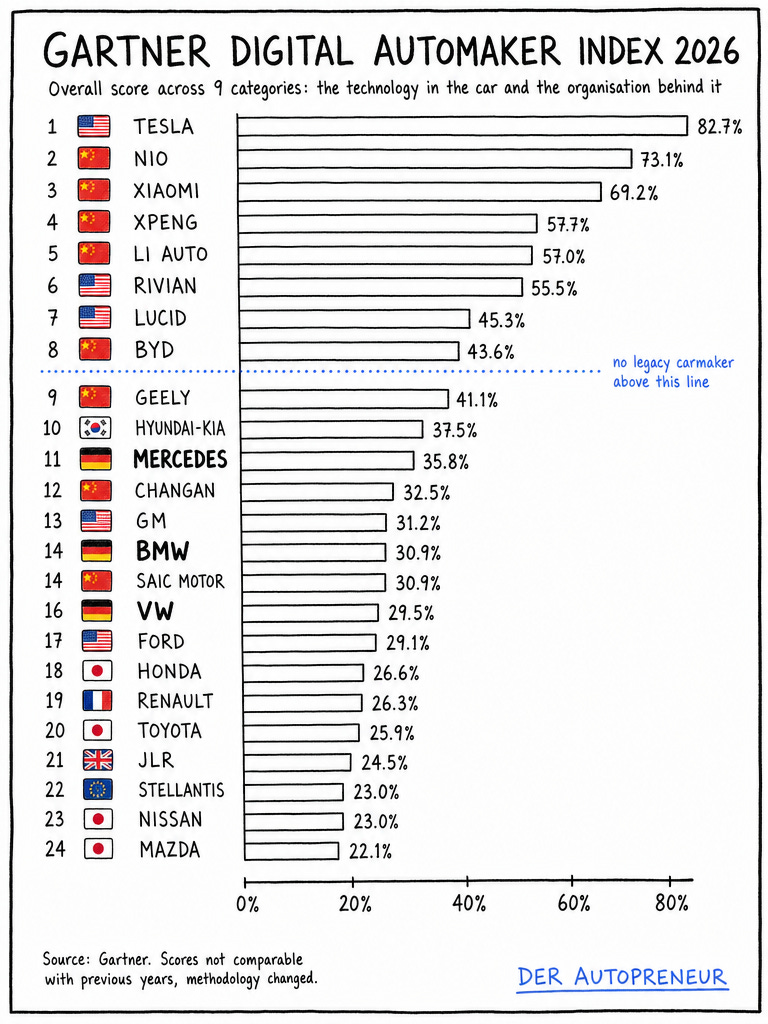
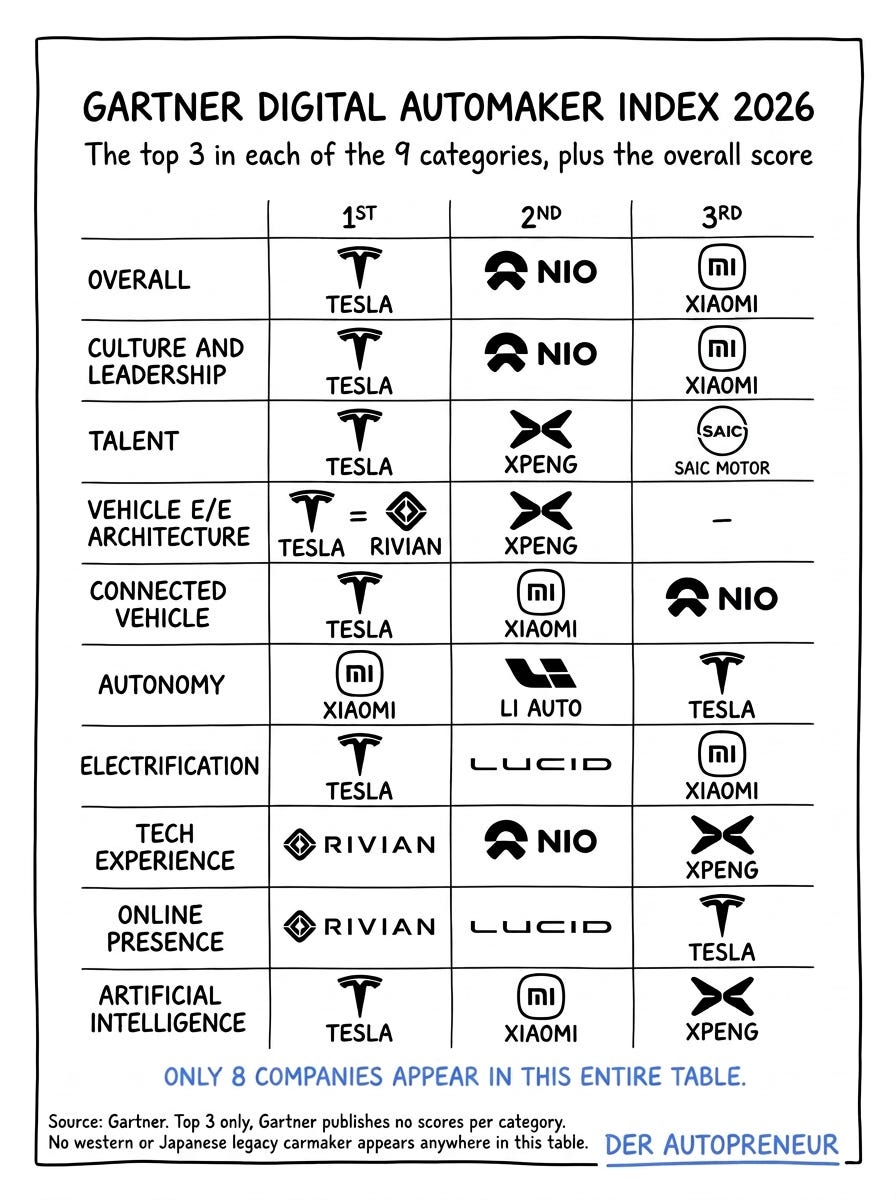
What the Gartner Digital Automaker Index measuresFirst, the basics. Gartner is one of the biggest analyst firms in the world. Once a year it scores 24 carmakers. And it scores both sides: the technology in the car and the organization behind it. There are 9 categories in total. Among them:
What stands out:
What strikes me: almost nothing has moved at the top in 3 years. The results look a little boring. But I think that's the real news. So my takeaways from past years still hold:
Gartner sees it the same way. The carmakers with the most mature organizations already have the most advanced tech in the car. Its data has shown that for years.
So what is software in a car?The industry has a name for this: the software-defined vehicle. The basic idea is less technical than it sounds. It's about how a car gets developed: do you start from the software or from the hardware? It comes down to 4 things:
Which leaves one question: what do we need all of that for? Why software in a car is more than a gimmickIn Germany you hear this a lot: "I don't need all the gimmicks. I want to get from A to B." "The Chinese are better at the apps and the toys. Karaoke in the car. But other than that, we build better cars." That's understandable. Germans see software as an add-on, an option you tick or you don't. Yet software runs almost every function in a car today. Adjusting your seat is software. So is automatic emergency braking. But the bigger point comes before all that: how a car gets built. A classic carmaker is essentially an integrator. It designs the car. Hundreds of suppliers build it. Each one delivers its part, and each part has one of those control units, running its own software. On top of that, a single function almost never sits in just one control unit. It runs across many of them, from different suppliers. That creates enormous product complexity. You have to coordinate every change across all those parts. Which makes software updates extremely expensive. Or close to impossible. The software-defined car takes that complexity apart. And that solves the problems the German car industry struggles with most:
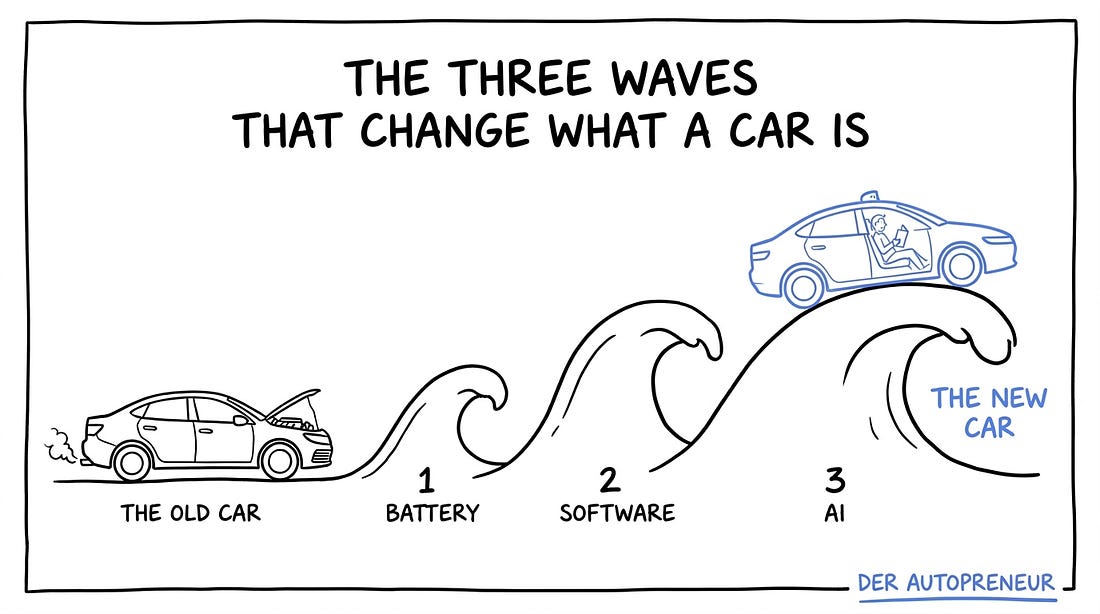
Take that last one. The story the industry tells itself: the world car doesn't work anymore. Customers in China want something different from customers in Europe. And that part is true. But the industry often draws the wrong conclusion: that every market needs its own car. That kills the economies of scale. And nobody can afford it. In the software-defined car the hardware stays the same. The software does the adapting instead, and that's far cheaper. So the underlying problem is this: software is still often treated as an option. In reality it's the foundation of the product. But the most important point comes next. Battery, software and AI build on each otherI always describe what's happening to the industry as 3 technology waves: battery, software, artificial intelligence. These waves aren't independent. Each builds on the one before. And each is what makes the next possible.
Wave 1: the battery At first glance it's just a different powertrain. But the battery changes everything. To see why, look at what it replaced. The combustion engine was the moat around the car industry. It was so complex that it worked as a barrier to entry. Anyone who wanted into the market had to pull off 2 things at once:
So for decades almost no new carmakers emerged. The market was sealed off. And whoever was already inside had it easy. The battery drained that moat. The complexity was gone, and suddenly almost anyone could build a car. And that's exactly what happened: a whole generation of new carmakers showed up at once. They're the ones at the top of Gartner's list today. The part that really hurts in Germany: mechanical engineering no longer sets you apart. And that was the very thing that made a car valuable. So anyone who still wants to stand out has to do it somewhere else. Wave 2: software The difference now comes from the software. That means the car is designed from the software up, the way I described above. Tesla invented that concept, and that's no accident. Because it means rethinking the car completely. An established market leader doesn't do that. A company that's been winning in a stable market for decades doesn't rethink what made it win. It repeats the formula and refines it. And it won't cannibalize its own product and wreck the business it already has. So it took a new generation of carmakers. And that generation only arrived with the electric car. That's why almost nobody builds a software platform for a combustion car. Wave 1 is what made wave 2 possible. And the next wave builds on that software. Wave 3: artificial intelligence I mean the AI that drives the car. The driver becomes a passenger. In a few years hardly anyone will drive their own car. As a hobby at most. And that only works with an electric car that runs on a software platform. That's why nobody builds robotaxis with combustion engines. Or without a software platform. So anyone who wants a part in the car of the future has to go through all 3 waves. Where the German carmakers standThe IAA in Munich is Germany's big auto show. The 2025 edition made one thing clear: the Germans have caught up on electric cars. Range and charging speed are on par with the competition now. They're a few years late, but they got there. Wave 1: done ✅ So where do they stand on wave 2, the software? Specifically: who already has a software-defined car on the road?
So the first software-defined cars from German carmakers have been on the road since 2025. That's a good start. The pattern is the same as with the battery, though. The Germans are a few years late on this wave too. Tesla's first software-defined car launched in 2017. That was 9 years ago. Tesla is on its 4th generation by now. The Germans are on their first. After 4 generations you don't just have a better product. You've also built an organization that knows what matters. The early bugs are ironed out and the processes work. And of course, you're ahead. So how do you close a gap like that? What the legacy carmakers are doing nowThe answer is almost always the same: they buy the skills and the technology from outside. I covered that for VW in the last issue. Stellantis is doing much the same. Gartner scores that too, by the way: whether a carmaker develops its technology itself or buys it. Buying counts for less. Buying isn't wrong in itself. It works as long as the carmaker understands the technology. Ideally better than its supplier does. Because only then does it know what it's actually buying. And only then does it keep control over its own product. And that's exactly where the risk lies. You can't buy your way through a shift like this. A company that doesn't build a product generation itself never learns what goes wrong along the way. It builds no skills of its own. And no organization that can deliver products like that. So the learning gets outsourced to the supplier. The supplier gets better with every generation. The carmaker doesn't. And then the whole thing feeds on itself:
A downward spiral. My TakeI think the problem is bigger than the car industry. In Germany, we never really made it into the information age. There are plenty of reasons for that. I'll focus on 2:
That worked for a long time. A very long time. And somehow we always got through. Until now. Because suddenly the old business models don't carry us anymore. And not just in one place. It feels like everywhere at once. The world now stands at the threshold between the information age and the AI age. And we still have one foot in the industrial age. That goes far beyond cars, of course. But the car industry is right in the middle of it. Carmakers are mechanical engineering companies at heart. And the people making the decisions there today built their careers in the old world. We talk about software a lot. But when it really counts, the money goes somewhere else. Gartner's own verdict: the car is now the most technologically complex consumer product in the world. And yet most carmakers are still not run like technology companies. And today, a technology company is simply a software company. So, back to the question we started with: when is all this software in the car going away? It's not going anywhere. It was always more than the karaoke app. We just still haven't fully understood that. Take that lightly and you don't lose a feature. You lose the industry. 🔗 gar | ane | ait | ev | li | bmw A word from me Selling to BMW, Bosch, or Continental from outside Germany? Good luck. German automotive is a closed club. Built on trust, relationships, and decades of doing business face to face. Cold outreach doesn't work. Trade fairs cost €20,000 for maybe 3 real conversations. And nobody takes meetings with companies they've never heard of. I spent 10 years inside Mercedes-Benz. Today, 100,000 European automotive decision-makers follow me. From team leads to board level. They trust me. Because I speak their language. Literally. One partner generated 250 webinar signups. Another got 60 qualified leads at OEMs. I'm your bridge into German automotive. That’s all for today. Until next week, And as always: If you find value here, share it with someone who should read it too. That helps me a lot. Everything else I’m working on is here → Thanks for reading The German Autopreneur! Subscribe for free to receive new posts and support my work.
|


 Posts
Posts









0 Comments