If you'd like, let me know:What specific chapter or theme you want to exploreWhether you need a summary of the author's view on globalization or military technologyI can give you more details.
Are you looking for John Nutting's specific riding impressions from that test, or would you like to see how the modern Gold Star compares technically to its historical 1950s predecessor?
Four years ago, the new Indian owner of BSA launched its ‘retro’ styled Gold Star. John Nutting was at the UK launch
RELATED POSTS
The shock of the old
Four years ago, the new Indian owner of BSA launched its ‘retro’ styled Gold Star. John Nutting was at the UK launch
Being single again
It was a real shock to my system. Decades after I’d last attended the global launch of a new motorcycle, and out of the blue in 2022 an invitation came from the marketing people who were plugging the BSA Gold Star, developed by new owner Mahindra in India, to try out the machine.
I didn’t think twice. We’d been waiting a while since the news that one of the sub-continent’s biggest motorcycle manufacturers had bought the venerable British brand, so here I was at the Millbrook vehicle testing facility in the Midlands in company with the top brass at Classic Legends, part of Mahindra, and two or so dozen of the UK’s top motorcycle journalists, most of whom must have been half my age.
It crossed my mind that they might think that I was well-qualified to comment on what was a shameless update on one of the British industry’s greatest machines, the BSA DBD34 Gold Star. After all I had access to two classic British bikes, one a BSA CB32 350cc Competition single and a Triumph 6T Thunderbird 650cc twin. How wrong I was.
Here’s how the day transpired.
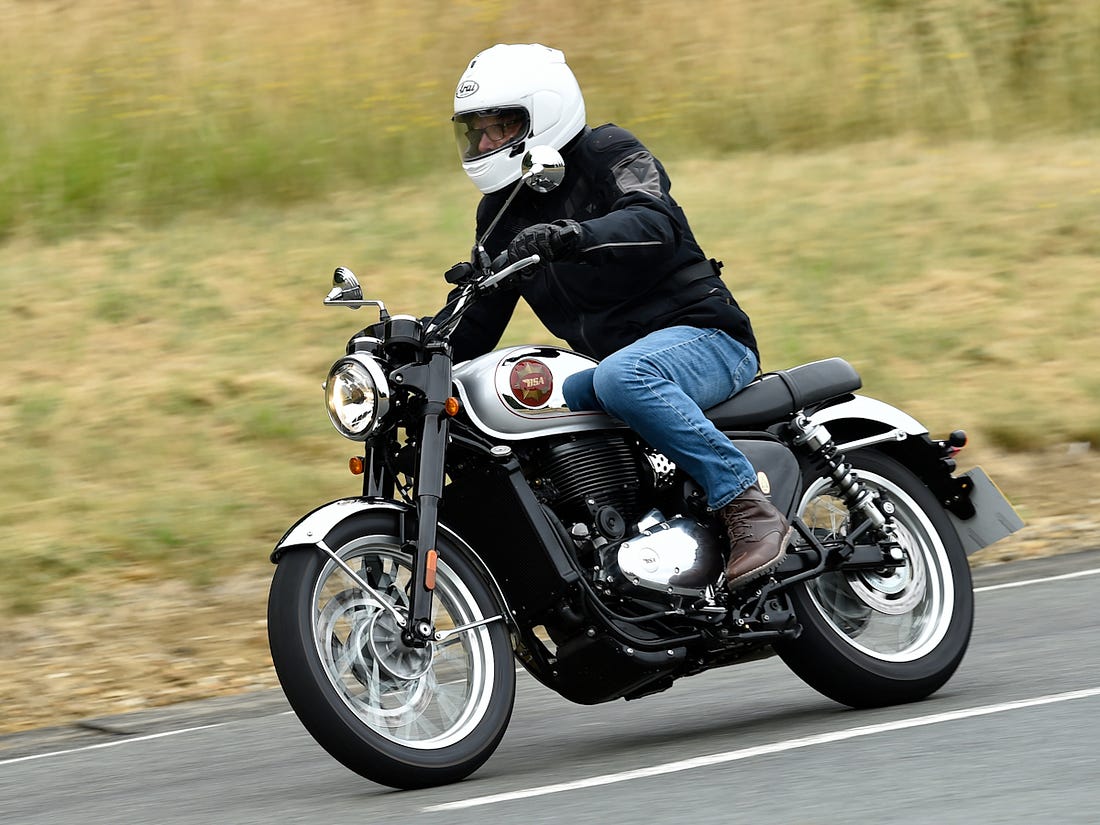
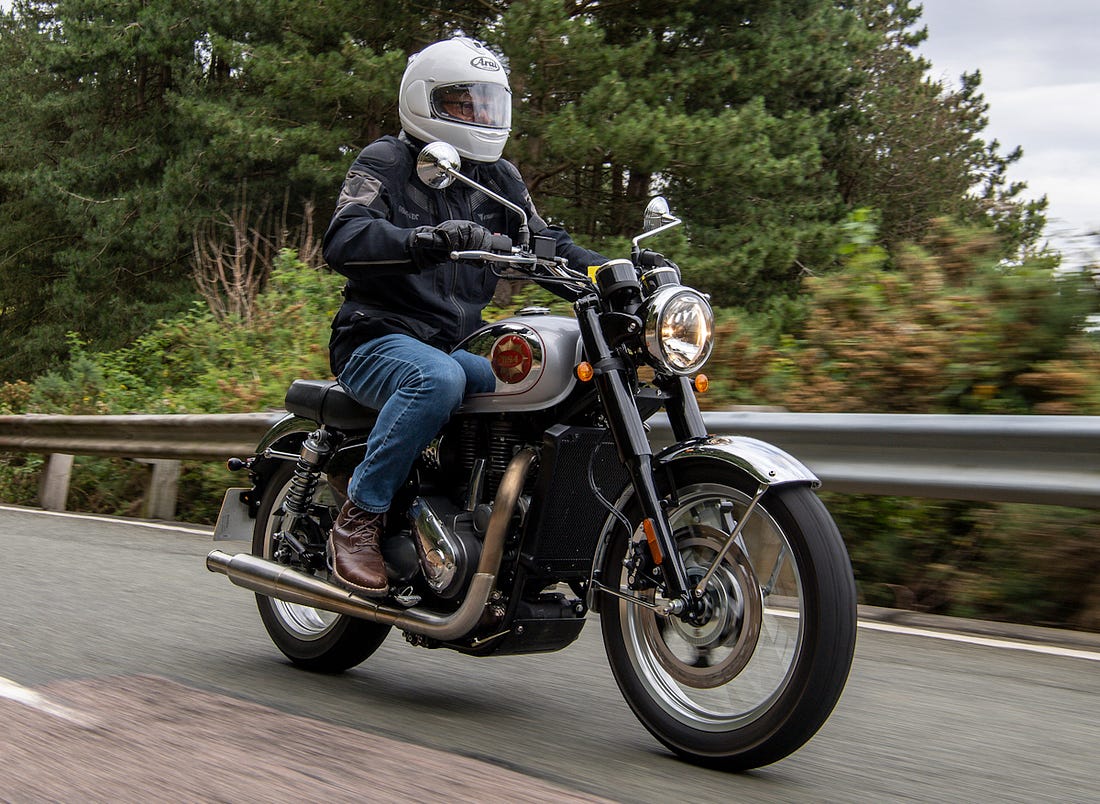
The author, part owner of a 1949 350cc BSA CB32 Competition, gets to grips with the new Gold Star’s easy-going handling. Image: Classic Legends
Budding bikers these days are probably unaware that the BSA factory at Small Heath in Birmingham was once the world’s biggest producer of motorcycles. Likewise even their fathers.
After all, it’s been almost half a century since the last ‘proper’ BSA was made in 1973 (the later rebranded Triumph T160s for the Saudi police don’t count, to my mind).
But in many circles the brand is one of the strongest and lives on ‘cool’ signage and clothing products.
That’s why Classic Legends, part of the large Indian-based Mahindra industrial group with sales of US$19 billion a year, bought the name in 2016 with a plan to revive the manufacture of BSA motorcycles in their spiritual home of Birmingham.
Now, after delays resulting the UK’s departure from the EU and Covid-related supply-chain interruptions, the first production models of the new BSA, called the Gold Star and recalling the fabled sports bike of the fifties, have been have been launched to the press.
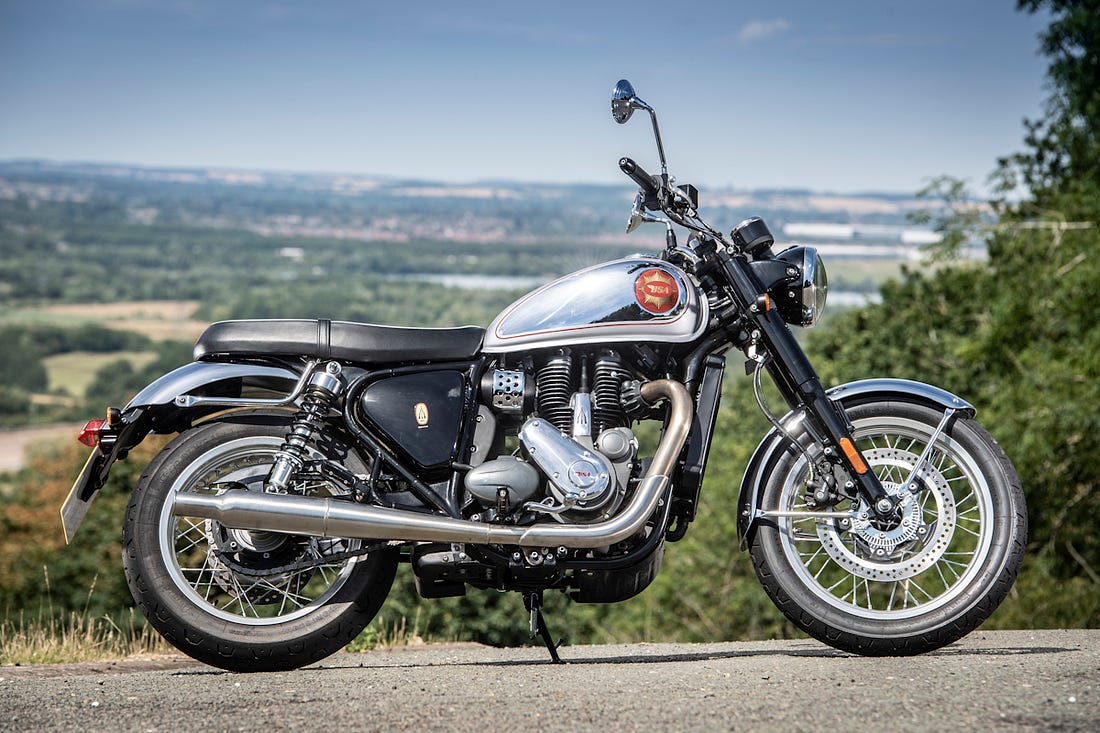
Top of the range of BSA Gold Star models is the Silver Sheen Legacy with lashings of chrome plate. Image: Classic Legends
When the Gold Star was first revealed at last December’s Motorcycle Live Show at the NEC, Mahindra chairman Anand Mahindra outlined how he saw it developing.
“BSA reigned supreme during the golden era of British motorcycles, renowned for their spirit and impeccable workmanship,” he said. “We’re incredibly honoured to be showcasing a new model that captures the DNA of such a legendary brand, which stamped an undeniable mark on the world of motorcycling. The next chapter in the brand’s history is going to be an exciting ride.”
Now, after further delays, BSA is back with the expectation that the Gold Star will be arriving in the showrooms of a growing network of dealers from mid-August.
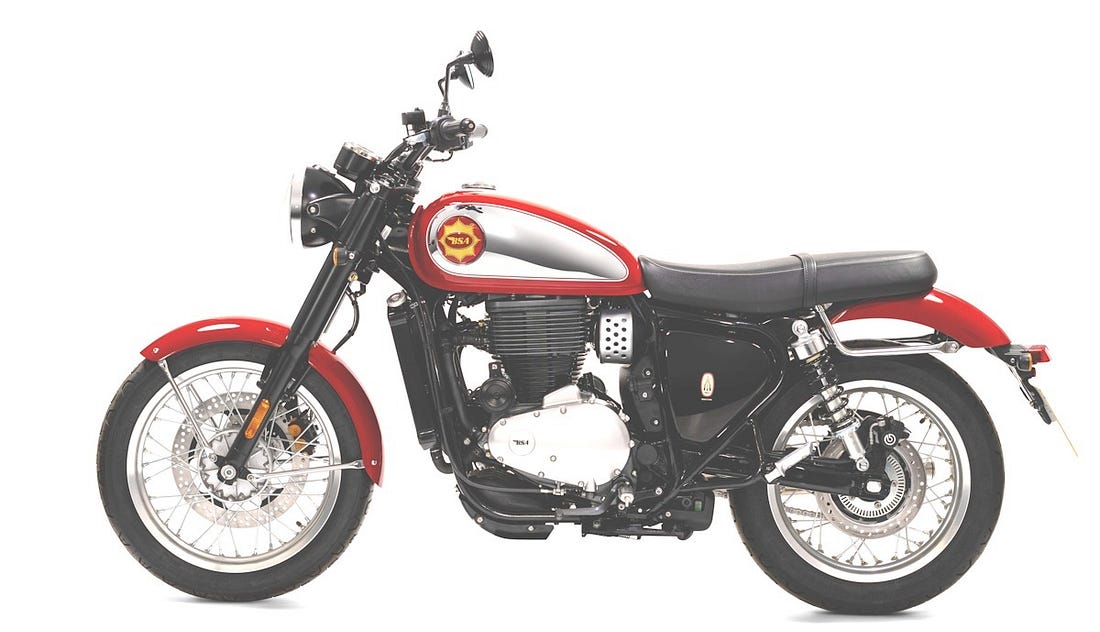
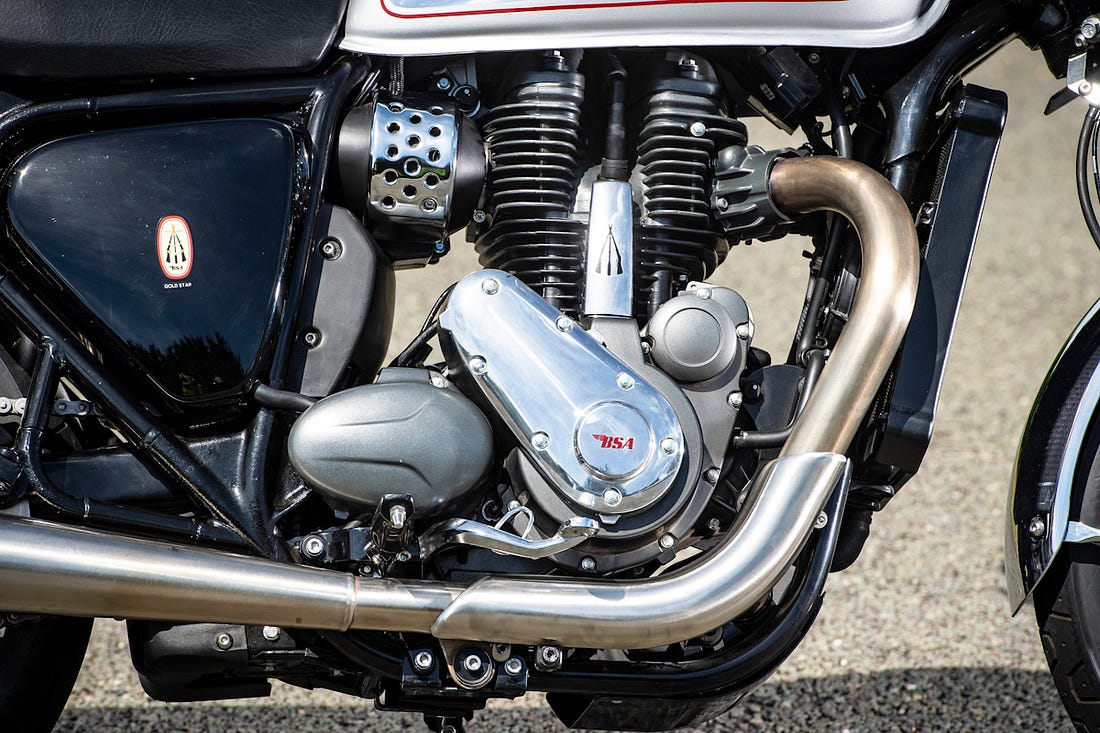
The more basic Insignia Red version of the 652cc Gold Star sold for £6,500 in 2022. To the author, the engine’s cock-eyed cylinder position looks like it’s AI generated. Image: Classic Legends
The new Gold Star is an A2 licence compliant machine aimed at first-time riders who may know the fabled BSA name but never had the opportunity to buy one new.
And it is pitched competitively in the market for classic retro machines like Royal Enfield’s cheaper 650cc Interceptor twin and the more expensive Triumph 900cc twins. Prices of the Gold Star start at £6,500 for the base Highland Green version, while the Insignia Red, Midnight Black and Dawn Silver versions with more complex graphics are £6,800.
Top of the range is the Silver Sheen Legacy, featuring chromed mudguards (rather than plastic), mirrors and levers, polished engine covers, a seat with white beading, and a gloss black finish on the instruments, headlight cover and footpegs, which is priced at £7,000. The bulk of the sales are expected to be of the top model.
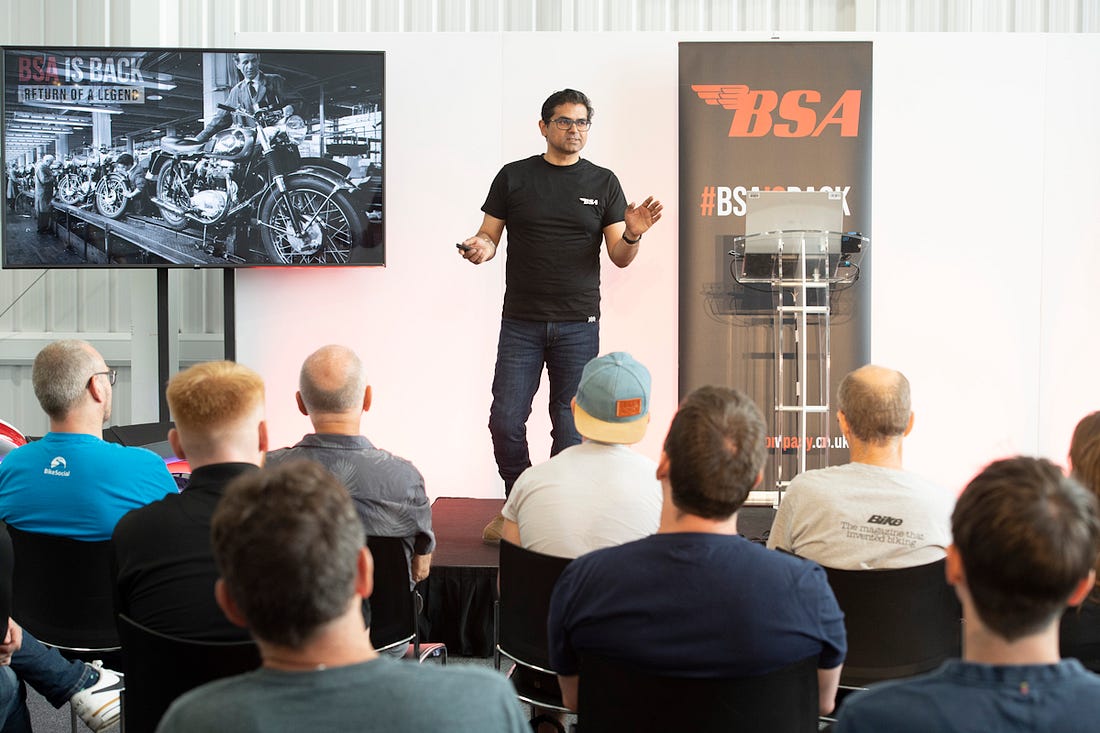
Ashish Singh Joshi, chief executive of Classic Legends, describes the philosopjy behind the BSA Gold Star relaunch. Image: Classic Legends
At the launch of the range at the Millbrook proving ground near Milton Keynes, Ashish Singh Joshi, a director of BSA Company Ltd which is owned by Classic Legends of which he is chief executive, said: “We’re delighted to announce the price of the new Gold Star. The response from the crowds at the Goodwood Festival of Speed, where the bike made its dynamic debut, and more recently, the Brooklands Motorcycle Show, has been fantastic.
“BSA has a rich history within the British motorcycle industry, and it will be very special to see the bikes back out on the road when the first deliveries arrive later this summer.” He has emphasised the importance of having the BSA designed in the UK, engineered in the UK and tested in the UK. “It’s a British bike and has to have a British ethos.”
While the ‘timing cover’ concealing the alternator looks the part, the faux ‘pushrod’ cover with the BSA insignia is a poor afterthought. Note the later cover of the exhaust pipe that covers the emissions equipment. Image: Classic Legends
Joshi leads a management team who are dyed-in-the-wool motorcyclists. He worked for a few years with Triumph Motorcycles in the UK before joining Royal Enfield and is therefore steeped in an understanding the growing market for classically-styled machines.
Equally enthusiastic is Anuparn Tharega, founder of Classic Legends, who has his own collection of machines. “This is a bike from the UK for the world,” says AT, as he is known. “We will start in the UK, then move into Europe, the US and Australasia.”
Classic Legends is just part of the motorcycle operations at Mahindra, which is a leading producer of bikes in India with brands that include Jawa and Yezdi, both of which have ranges of roadster, scrambler and adventure machines with engines up to 334cc. Mahindra also recently bought a controlling share in Peugeot’s two-wheeler business.
(The 334cc ohc singles were later rebranded and launched as the BSA Bantam in the UK).
So there is plenty of experience behind the design and development of the new BSA, which was carried out in the UK by the company’s own engineers who collaborated with Graz University of Technology in Austria, which also has done work for KTM. Chassis design was carried out by another technical partner, UK-based Ricardo Motorcycles.
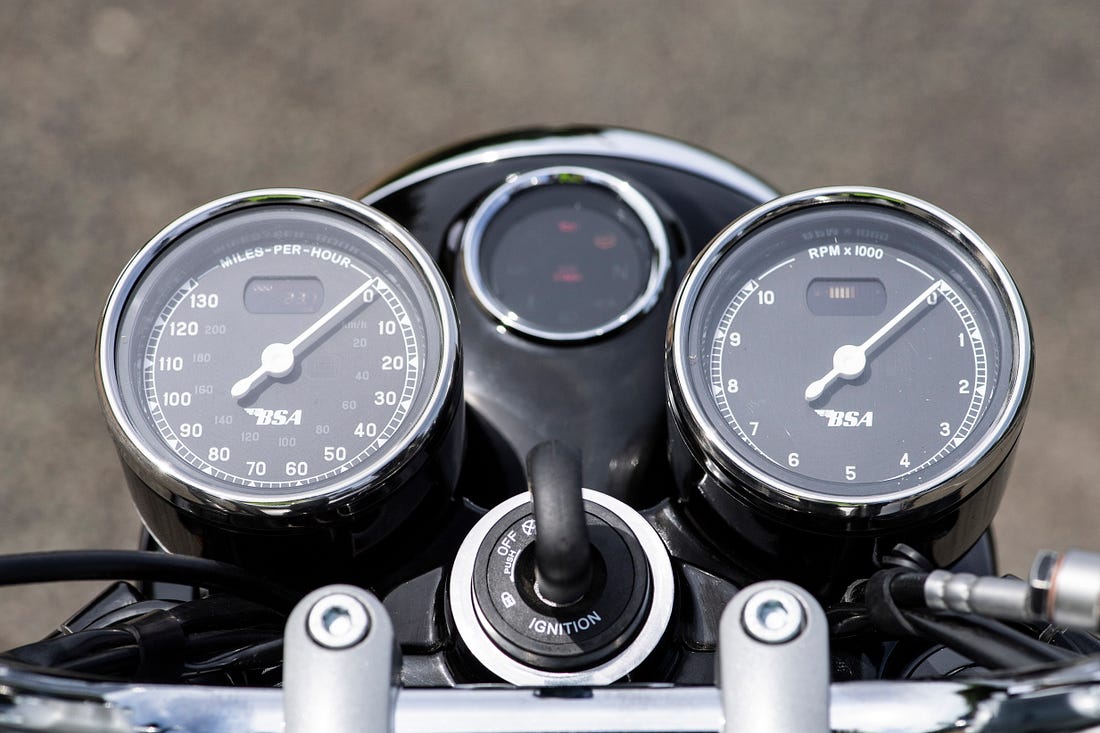
The instrument cluster is one of the best features of the Gold Star with well-styled classic dials for the speedo and tacho. Above the ignition key the former ammeter spot houses a range of warning lamps. Image: Classic Legends
Joshi describes the core values of the new Gold Star as “authenticity, honesty and reliability”. Although this might have been achieved by using one of BSA’s later twins as the theme, it was the sporty 500cc DBD34 Gold Star single that was seen as the more iconic.
The team have done what I think is a great job in capturing the lines of the original, with styling chief Balrag Ghataore, formerly a director of UK-based Redline Design, talking of the key features such as a the ‘vertical look’ and ‘distinctive parts’ with especially the key line through the headlamp’s centre to the fuel tank and seat. He’s especially proud of getting the fit of the chrome-plated steel tank and seat correct above the frame tubes, which also have to contain the airbox, battery and oil tank.
The proportions and ergonomics of the Gold Star are ideal for relaxed riding. The seat is slim and with a height unladen of 780mm that enables anyone with a 31-inch inside leg to stand astride with room to spare. The fold-up footpegs are trim but easy to find and the handlebar comfortably angled and positioned.
The new BSA Gold Star offers a relaxed riding position, almost like the author’s 1958 650cc Triumph 6T Thunderbird. Image: Classic Legends
There’s a good view ahead, with the rev counter and speedo featuring authentic-looking dials that read clockwise from 2 o’clock, just as the old chronometric instruments did while where the ammeter used to be in the headlamp is a small display of information like oil pressure, indicators, ABS, and the like. Being an owner of British bikes, I felt at home.
After switching on the machine with the key between the dials, the engine fires up promptly at the touch of the button next to the twistgrip, and settles into a 1,500rpm idle. For a big single, the unit feels surprisingly smooth but has a substance to it. That’s because its uses a single engine-speed balance shaft at the front of the cases to keep vibration in check. To meet Euro5 emission regs, the engine is liquid cooled with the radiator up front being a ‘necessary evil’.
The exhaust note is very subdued through the Gold Star ‘twitter-style’ pipe which has been revised since last year’s launch, with the ugly cover at the top cut back only to conceal the plumbing to the catalyser unit below the radiator. At speed though the bike emits a pleasing ‘thrum’ but many owners are likely to replace the pipe with something more rorty.
To maintain the look of the old Gold Star engine the top end has substantial but only cosmetic finning. Swept volume is 652cc with a highly-oversquare bore and stroke of 100 x 83mm. Hidden beneath the fuel tank the cylinder head contains double-overhead camshafts and twin inlet and exhaust valves, driven by an inverted-tooth chain on the same side as the primary drive gears and clutch, which is a slipper type. Interestingly, the crankshaft is a built-up unit with a floating big-end bush. Lubrication is dry sump with pressure and scavenge pumps fed by an oil tank under the left side below the seat, which can be unlocked to access the battery after the plastic cover is unclipped.
Maintaining the look of an old B-series BSA single, the ‘timing cover’ on the right side conceals the alternator and ignition system, which feeds twin spark plugs that are no doubt necessary with a high 11.5 to 1 compression ratio. But the ‘pushrod’ tunnel with the BSA triple gun logo is vestigial and to me looks too much like an afterthought. The front end is pure BSA with the mudguard’s stays at the correct angle and attached like many of the components with stylish stainless dome-head cap screws.
Newcomers to motorcycles will find the Gold Star easy to handle despite a dry weight of 198kg, which makes it a bit heavier than the Royal Enfield 650 twin. But it doesn’t feel intimidating and this extends to the crisp selection in the five-speed gearbox and light clutch action. The steel frame is made of welded steel tubing and castings with a good paint finish. Geometry is modernish with a generous 1,425mm wheelbase and shallowish 26.5 degree head angle. So steering is initially light while stable at speed.
The classic look is as much to do with the wheels and fittings. While aluminium alloy, the 36-spoked unvalanced rims are wide enough (2.5 x 18 front and 4.25 x 17 rear) to take modern Pirelli tubeless tyres that are more than grippy enough. The bike feels well planted at speeds up to 80mph but although I found the suspension comfortable and compliant while carving through the ups and downs of Millbrook’s road network it got a bit squirrelly on the circular bowl when approaching the ton, which is what the BSA people said the bike was capable of. That’s what I’d expect from a claimed 45bhp, the maximum allowed for A2 licence holders. Top gear – at 5.0 to 1 giving 96mph at 6,500rpm – is more of an overdrive for cruising: at an indicated 70mph the rev counter showed 4,300rpm but it feels more lazy than that.
Much was made of the engine’s flexibility which according to Joshi is largely due to its maximum torque of 55Nm being delivered at modest revs. This means that twistgrip response from the ride-by-wire twistgrip improves as the revs drop. The pickup was remarkably clean all through the range, without any jerkiness off idle. BSA claims that fuel consumption using the World Motorcycle Test Cycle procedure is slightly better than 70mpg, giving a useful range on the 12-litre (2.64 gallon) tank of at least 150 miles.
The BSA’s braking, with dual-channel ABS, was particularly reassuring. Disc brakes may not have the classic look but the Brembos, with the 320mm front disc gripped by a dual-piston caliper up front and a smaller 255mm rear with a floating caliper, offered smoothly-controlled stopping power with no obvious risk of locking.
Modern features include a handlebar mounted USB port, and a power socket for things like heated jackets. But diehards will wonder why the Gold Star doesn’t have a centre stand, as on the original. Such is the nature of fitting everything into a modern machine, including the ABS tackle which is underneath the swing-arm pivot, so that there’s no room.
BSA is planning to offer a wide range of accessories for the bike, and expects aftermarket specialists to get involved, so a centre-stand, for those who like lubricating their drive chain on a Sunday morning, might arrive later.
That’s all part of a wider strategy to build BSA. In due course, assembly of the bike will come to the UK (it’s made on a special production line adjacent to the others at the plant in India) and will join projects such as an electric bike, for which BSA has been awarded a multi-million grant from the UK government to develop with Ricardo.
BSA Gold Star specification
Model BSA Gold Star 2022 Engine Liquid-cooled dohc four-valve single Capacity 652cc (100 x 83mm) Compression ratio 11.5 to 1 Lubrication Dry sump Ignition Digital inductive, twin plugs Fuelling Fuel injection Peak power 45bhp at 6,500rpm claimed Peak torque 55Nm at 4,000rpm claimed Primary drive Spur gears, ratio 1.95 to 1 Clutch Wet multiplate, slipper type Gearbox Five speed, internal ratios: 2.75, 1.75, 1.31, 1.05 and 0.88 to 1 Final drive 530 chain, ratio 2.94 to 1 Overall gear ratios 15.7, 10.0, 7.5, 5.98 and 5.0 to 1. Frame Duplex tubular steel cradle Front suspension Telescopic fork, 41mm legs Rear suspension Swing arm, twin shocks, adjustable preload. Wheels Laced spokes, aluminium rims, MT2.50-18 front MT4.25-17 rear Tyres Pirelli Phantom Sportcomp, 100/90-18 front, 150/70-R17 rear Front brake Single 320mm hydraulic disc, dual piston Brembo, ABS Rear brake 255mm disc, ABS Battery 12V-12Ah Fuel tank 12 litres Wheelbase 1,425mm Seat height 780mm Castor angle 26.5deg
Weight 198 kg dry claimed
John Nutting is free today. But if you enjoyed this post, you can tell John Nutting that their writing is valuable by pledging a future subscription. You won't be charged unless they enable payments.
Creates, proofreads, and polishes specialized text about cars, trucks, motorcycles, vehicle All news is taken from a reliable source taken from or from wikipedia, and the motor industry.




 Posts








0 Comments