


RELATED POSTS
Will GLP-1 drugs change home design?
Nobody is going to want to look at that big kitchen island anymore.
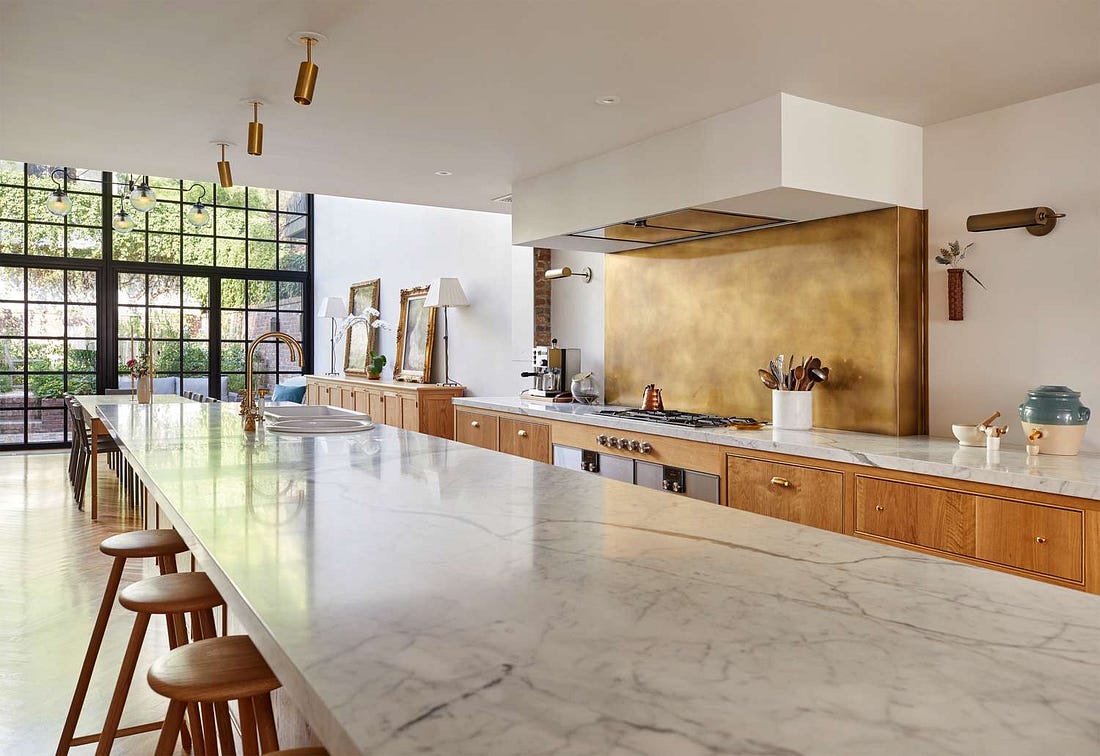
Writers of a certain age (like me) often see things happening today and whine, “I predicted that 20 years ago!” Readers of a certain age may remember Faith Popcorn (yes, her real name, legally changed from Plotkin). She is a futurist and marketing consultant who invented the word “cocooning” in 1982, describing it as “a desire to protect oneself from the harsh realities of the outside world” and has been making predictions ever since. She is 83 now and is having an “I told you so!” moment after reading an article in AD titled This Is Your Home on GLP-1s, about how the drugs are changing the design of our homes- it is subheaded “As GLP-1s reshape American life, they’re also sparking a surprising behind-the-scenes transformation of our homes, from med-station bathrooms to ghost-town kitchens” In 1996, Popcorn predicted drugs that fool our appetites, and in 2001 wrote that “the kitchen becomes increasingly vestigial.” And here we are, 30 years later, and the big kitchens with monster islands that I always complain about might be going away, because the way many people eat is changing due to appetite-suppressing GLP-1 drugs. Will this change the way our homes are designed? Interior Designer Elizabeth Valkovics tells AD:
I am having a similar “I told you so!” moment too, complaining for years that the kitchen was turning into a large closet with small appliances, variously called messy kitchens or now scullery kitchens, to hide the microwaves and the Kuerigs, where you toast your Eggos or unpack the Uber Eats, with big open kitchens there for hobbyists or for show. But what happens if nobody has an appetite anymore, what’s the point? Who wants to invest in all that equipment or real estate? Who wants to look at it? According to another design strategist:
The kitchen is becoming, as I predicted, an “enhanced pantry space” for targeted food prep. Our strategist continues:
22% of households now have at least one person on GLP-1 drugs, and the users skew rich, with 40% earning more than $100K. They are the ones who used to covet the big, sprawling kitchen; now I suspect many are losing interest in it. Then there’s another demographic trend: more people living alone, rising from 13% in 1960 to 29% today and expected to hit 35% by 2050. Then there is the appification of eating: according to the USDA, Americans now spend more money eating out than eating in. Even when we cook at home, what we eat has changed. According to a Circana study,
Popcorn’s prediction for 2030: “The six-burner range becomes a period piece, and in some homes the wet bar is the only kitchen.” My prediction from 2019: “I suspect that the big range with oven is on its way out, and small, moveable and storable appliances will take over.” I once wrote that the kitchen was going the way of the sewing machine- a hobby enjoyed by a few. There will always be people (like spouse Kelly) who love to cook, just as there will always be people (like daughter Emma) who love to sew. But I see so many trends pushing the other way:
Faith Popcorn sees the kitchen of the future as an elaborate wet bar. She predicts that “GLP-1s will make meals fewer and smaller, but the change does not stop at the body. It empties the pantry, shrinks the range, and moves the refrigerator into the bedroom.” Changes are coming not only to the kitchen, but to every room in the home. People are drinking less but are evidently entertaining more; living rooms may become games rooms. As people shrink, so might their furniture, although the TVs might get bigger. Much of the action moves to the bathroom; fridges become important for storing everything from peptides to GLP-1 shots. Sharps disposal is also an issue. The bathroom is also turning into a “wellness hub,”
This is one of my “I told you so!” moments, where I go back to Le Corbusier’s Manual of the Dwelling. He wrote in 1924:
It was truly a wellness hub, except for the toilet, which he hid in a tiny closet. Elyse Moody in AD notes that designers are specifying more soaking tubs and saunas; I suspect we will see more gym equipment here. Others worry about this trend. Writing in ADpro, Architect Chinmay Misra is concerned about the changing focus.
Faith Popcorn has a great insight: “Behavior comes first, and construction follows.” A hundred years ago, with Aalto, Neutra, and Le Corbusier, modern design was organized around the fear of tuberculosis and the idea of fighting disease with design. Much of this was forgotten or ignored when we got antibiotics, but then we got a pandemic, and air quality, health and wellness became a concern.
I wrote recently that longevity architecture has become a thing, and now we have GLP-1 drugs. People are changing their behaviour, focusing on staying healthier longer. Popcorn is right; design and construction will follow. Special offer! Now with your choice of book!
I do not want to put up a paywall on this site, but it provides a meaningful portion of my income. So here’s a limited-time offer: I will send a signed copy of the print edition of either “Living the 1.5 Lifestyle” or “The Story of Upfront Carbon” to anyone in the USA or Canada who signs up for a one-year subscription (C$50, cheap at about US$37 ).
|





 Posts
Posts









0 Comments